
Coil Heater Temperature & Watt Density Guide
Coil heater temperature and watt density are important factors when selecting a heater for injection molding, extrusion, hot runner systems, and other cylindrical heating applications.
The right coil heater depends on more than total wattage. Operating temperature, watt density, material, inner diameter, heated width, installation fit, and heat loss should all be considered together.
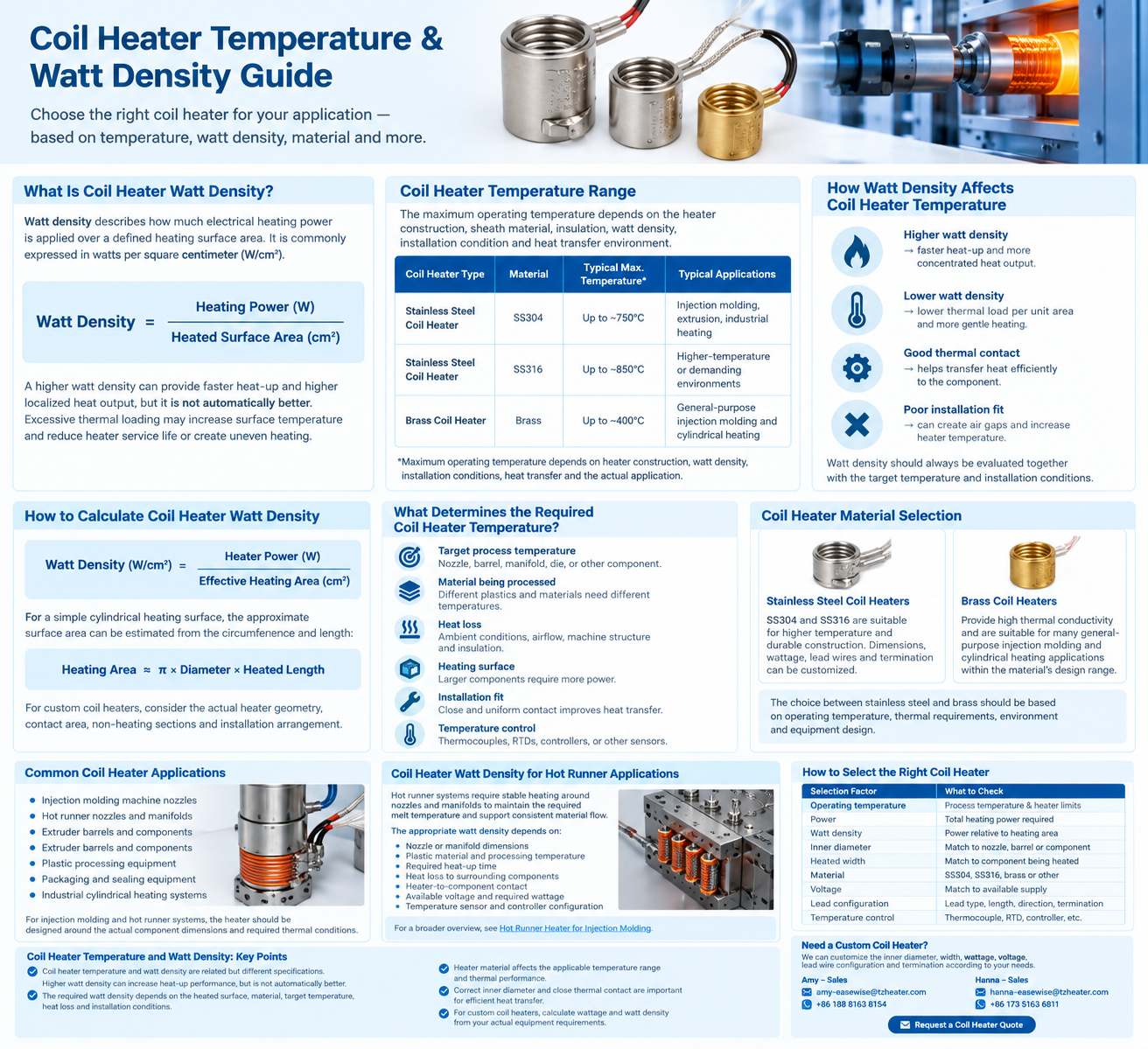
What Is Coil Heater Watt Density?
Watt density describes how much electrical heating power is applied over a defined heating area. It is commonly expressed in watts per square centimeter (W/cm²).
The basic relationship is:
Watt Density = Heating Power ÷ Effective Heating Area
A higher watt density can provide faster heat-up and more concentrated heat output. However, higher watt density is not automatically better. The heater must be matched to the material being heated, target temperature, installation fit, and heat-loss conditions.
For current coil heater sizes, materials, wattages, and customization options, see the EaseWise Coil Heater product page.
Coil Heater Temperature Range
The operating temperature of a coil heater depends on its construction, sheath material, insulation, watt density, installation condition, and heat transfer environment.
| Coil Heater Type | Material | Maximum Operating Temperature* | Typical Applications |
|---|---|---|---|
| Stainless Steel Coil Heater | SS304 | Up to approximately 750°C | Injection molding, extrusion, industrial heating |
| Stainless Steel Coil Heater | SS316 | Up to approximately 850°C | Higher-temperature or demanding environments |
| Brass Coil Heater | Brass | Up to approximately 400°C | General-purpose injection molding and cylindrical heating |
*Actual operating temperature depends on the heater construction, watt density, installation, heat transfer, and application conditions.
How Watt Density Affects Coil Heater Temperature
Watt density and operating temperature are related, but they are not the same specification.
Watt density describes how concentrated the heating power is over the effective heating area. Operating temperature depends on the balance between heat generated by the heater and heat transferred to the component and lost to the surrounding environment.
- Higher watt density: can provide faster heat-up and concentrated heat output.
- Lower watt density: can reduce localized thermal loading where gentler heating is required.
- Good thermal contact: improves heat transfer from the heater to the heated component.
- Poor installation fit: can create air gaps and reduce effective heat transfer.
For this reason, watt density should be selected together with the target temperature and actual installation conditions.
How to Calculate Coil Heater Watt Density
The basic calculation is:
Watt Density (W/cm²) = Heater Power (W) ÷ Effective Heating Area (cm²)
For a simple cylindrical heating surface, the approximate surface area can be estimated as:
Heating Area ≈ π × Diameter × Heated Length
For custom coil heaters, the actual heater geometry should be considered because non-heating sections, terminals, contact area, and installation arrangement can affect the effective heating area.
For OEM applications, it is therefore better to calculate watt density from the actual heater drawing, component dimensions, and required operating conditions rather than applying one generic value to every coil heater.
What Determines the Required Coil Heater Temperature?
The required heater temperature depends on the process temperature that must be maintained and the amount of heat lost during operation.
- Target process temperature: Required temperature of the nozzle, barrel, manifold, die, or other component.
- Material being processed: Different plastics and industrial materials require different processing temperatures.
- Heat loss: Ambient temperature, airflow, machine structure, and insulation affect heating requirements.
- Heating surface: Larger components generally require more heating power.
- Installation fit: Close and uniform contact improves heat transfer.
- Temperature control: A thermocouple or other temperature sensor can provide feedback to the controller.
For temperature measurement and control options, see the EaseWise Thermocouple product range.
Coil Heater Material Selection
Stainless Steel Coil Heaters
Stainless steel coil heaters are suitable for applications requiring higher operating temperatures and durable heater construction. SS304 and SS316 configurations can be selected according to temperature and environmental requirements.
Brass Coil Heaters
Brass coil heaters offer high thermal conductivity and are commonly used for general-purpose injection molding and cylindrical heating applications within their design temperature range.
The choice between stainless steel and brass should be based on operating temperature, thermal requirements, environment, and equipment design.
Coil Heater Watt Density for Hot Runner Applications
Hot runner systems require stable heating around nozzles and manifolds to maintain the required melt temperature and support consistent material flow.
Coil heaters can provide concentrated external heating around cylindrical hot runner components. The heater should be matched to the component diameter, heated length, required power, and temperature-control system.
Important factors include:
- Nozzle or manifold dimensions
- Plastic material and processing temperature
- Required heat-up time
- Heat loss to surrounding components
- Heater-to-component contact
- Available voltage and required wattage
- Temperature sensor and controller configuration
For more information about hot runner heating, see the Hot Runner Heater Applications guide.
How to Select the Right Coil Heater
| Selection Factor | What to Check |
|---|---|
| Operating temperature | Required process temperature and heater construction limits |
| Power | Total heating power required |
| Watt density | Power concentration over the effective heating area |
| Inner diameter | Match the nozzle, barrel, or cylindrical component |
| Heated width | Match the required heating area |
| Material | SS304, SS316, brass, or another suitable construction |
| Voltage | Match the available electrical supply |
| Lead configuration | Lead type, length, direction, and termination |
| Temperature control | Thermocouple, RTD, controller, or other sensor |
Common Coil Heater Applications
Coil heaters are commonly used where uniform external heating is required around cylindrical components.
- Injection molding machine nozzles
- Hot runner nozzles and manifolds
- Extruder barrels and die heads
- Plastic processing equipment
- Packaging and sealing equipment
- Other industrial cylindrical heating systems
Key Points for Coil Heater Temperature and Watt Density
- Coil heater temperature and watt density are related but different specifications.
- Higher watt density can increase heat-up performance, but higher is not always better.
- Watt density should be matched to the heated component, target temperature, material, and heat-loss conditions.
- Heater material affects the applicable temperature range.
- Correct inner diameter and close thermal contact are important for effective heat transfer.
- Custom coil heaters should be specified according to the actual equipment requirements.
Need a Custom Coil Heater?
EaseWise supplies custom coil heaters for injection molding, hot runner systems, extrusion, packaging, and other industrial heating applications.
We can customize the inner diameter, heated width, voltage, wattage, lead-wire configuration, and termination according to your equipment requirements.
For a quotation, please send your heater drawing or sample information together with the required voltage, wattage, dimensions, quantity, and target operating temperature.
Amy – Sales
Email: amy-easewise@tzheater.com
WhatsApp: +86 188 8318 8154
Hanna – Sales
Email: hanna-easewise@tzheater.com
WhatsApp: +86 173 5163 6811