
Grounded vs Ungrounded Thermocouple for Industrial Temperature Measurement
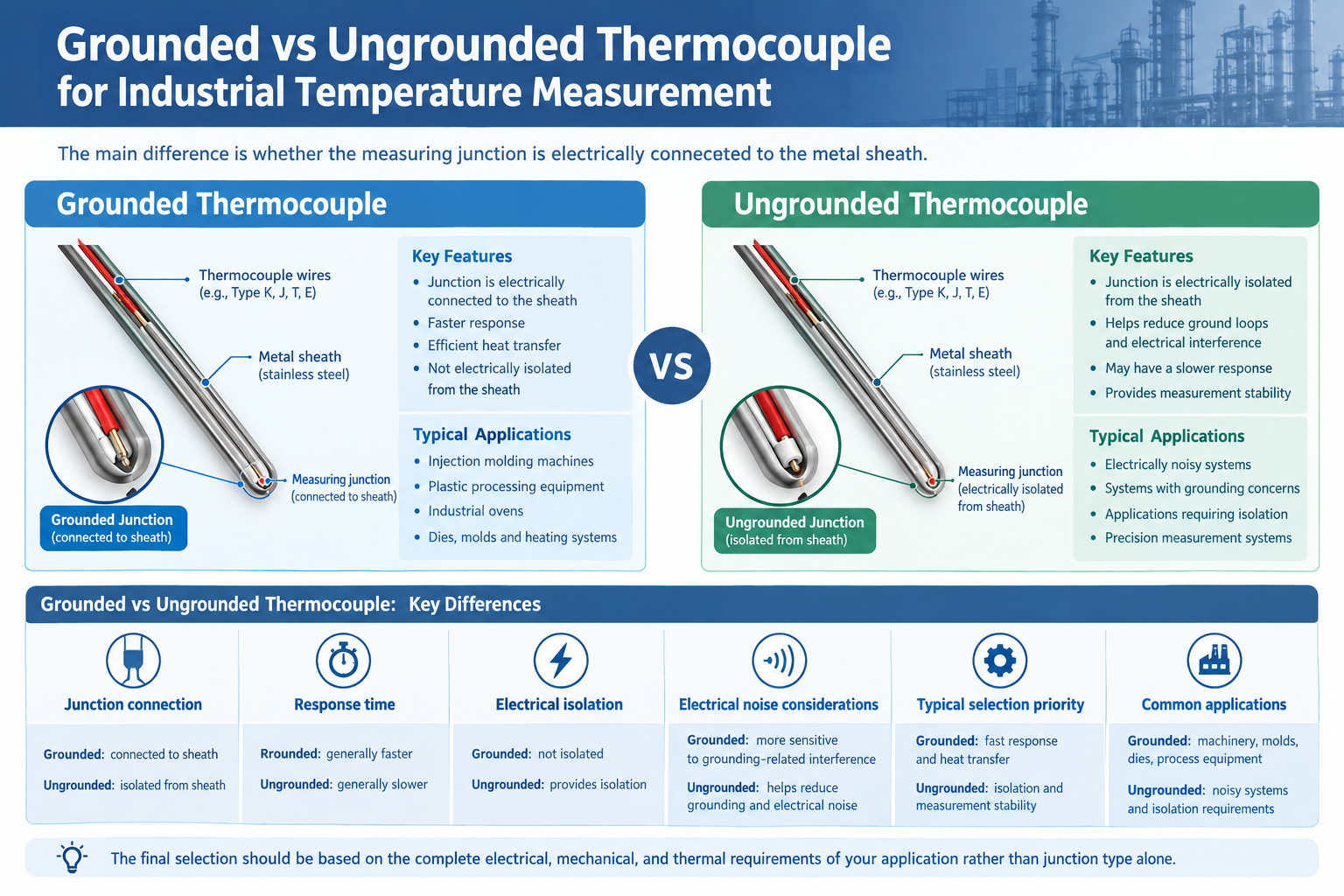
When comparing a grounded vs ungrounded thermocouple for industrial temperature measurement, the junction design is an important consideration. The main difference between a grounded thermocouple and an ungrounded thermocouple is whether the measuring junction is electrically connected to the metal sheath.
A grounded junction generally provides faster response and good heat transfer, while an ungrounded junction provides electrical isolation between the thermocouple junction and the sheath. The right choice depends on response time, electrical noise, instrumentation, and the application environment.
What Is a Grounded Thermocouple?
In a grounded thermocouple, the thermocouple junction is electrically connected to the protective metal sheath. This construction allows heat to transfer efficiently from the sheath to the measuring junction.
Grounded thermocouples are commonly used where fast temperature response is important and electrical isolation is not a primary requirement.
Advantages of Grounded Thermocouples
- Faster response compared with many ungrounded constructions
- Efficient heat transfer through the metal sheath
- Suitable for applications requiring relatively quick temperature detection
- Commonly used in industrial machinery and process equipment
Typical Applications
Grounded thermocouples can be suitable for injection molding machines, plastic processing equipment, industrial ovens, dies, molds, and other heating systems where fast temperature measurement is required.
For a broader overview of industrial temperature sensors and available configurations, see our Thermocouple product page.
What Is an Ungrounded Thermocouple?
In an ungrounded thermocouple, the measuring junction is electrically isolated from the protective metal sheath. The junction is separated from the sheath so that the thermocouple circuit remains electrically isolated from the equipment being measured.
This construction is useful when electrical isolation is important or when the measuring system may be affected by electrical interference or grounding differences.
Many industrial temperature sensors use a protective sheath to provide mechanical protection and stable installation. For more information about this sensor construction, see our Sheathed Thermocouple product page.
Advantages of Ungrounded Thermocouples
- Provides electrical isolation between the junction and sheath
- Can help reduce problems caused by ground loops and electrical interference
- Suitable for systems where sensor isolation is important
- Useful when the measuring instrument requires an isolated thermocouple circuit
Grounded vs Ungrounded Thermocouple: Key Differences
| Feature | Grounded Thermocouple | Ungrounded Thermocouple |
|---|---|---|
| Junction connection | Connected to the metal sheath | Electrically isolated from the sheath |
| Response time | Generally faster | Generally slower |
| Electrical isolation | Not electrically isolated from the sheath | Provides electrical isolation |
| Electrical noise considerations | May be more sensitive to grounding-related interference | Can help reduce grounding and electrical interference issues |
| Typical selection priority | Fast response and efficient heat transfer | Electrical isolation and measurement stability |
| Common applications | Industrial machinery, molds, dies, process equipment | Electrically noisy systems and applications requiring isolation |
Grounded Thermocouple: When Should You Choose It?
A grounded thermocouple may be appropriate when fast temperature response is an important requirement and the sensor can be electrically connected to the surrounding metal structure without causing measurement problems.
For example, injection molding and plastic processing equipment may require rapid temperature feedback for heating zones, molds, dies, or other components. In these applications, the faster response of a grounded junction can be useful.
However, the complete electrical system should also be considered. If the equipment contains multiple grounded components, drives, controllers, or other sources of electrical interference, the grounding arrangement should be checked before selecting a grounded junction.
Ungrounded Thermocouple: When Should You Choose It?
An ungrounded thermocouple is often considered when electrical isolation is more important than achieving the fastest possible response.
Isolation can be particularly useful in systems where the thermocouple is installed on electrically active equipment or where multiple sensors and instruments may create unwanted ground paths.
For temperature measurement systems with electrical noise or grounding concerns, an ungrounded junction can help isolate the thermocouple measurement circuit from the protective sheath.
Response Time vs Electrical Isolation
The choice between grounded and ungrounded construction often involves a trade-off between response time and electrical isolation.
A grounded junction normally transfers heat efficiently through direct contact with the sheath, which can provide a faster response. An ungrounded junction introduces electrical isolation between the measuring junction and sheath, and this construction can have a slower response depending on the sensor design.
Actual response time also depends on the thermocouple diameter, sheath material, sheath thickness, installation method, measured medium, and operating conditions. Therefore, junction type should not be considered independently from the overall sensor construction.
Grounded vs Ungrounded Thermocouple for Industrial Equipment
Different industrial applications can have different priorities when selecting a thermocouple junction design.
- Injection molding machines: Fast temperature response may be important for heating zones, molds, and dies.
- Plastic processing equipment: Thermocouples may be used to monitor barrel, nozzle, die, and process temperatures.
- Industrial ovens: Junction selection depends on response requirements, installation conditions, and electrical environment.
- Heating equipment: The required response time and electrical isolation should be considered together.
- Process equipment: Sensor construction should match the process temperature, installation method, and instrumentation.
How to Choose Between Grounded and Ungrounded Thermocouples
When selecting a thermocouple, consider the following application requirements:
- Required response time: Is rapid temperature detection important?
- Electrical isolation: Does the thermocouple need to be isolated from the sheath?
- Electrical environment: Are there drives, motors, heaters, or other potential sources of electrical interference?
- Installation location: Will the sensor be installed in a mold, machine, tank, oven, pipe, or process system?
- Temperature range: What are the normal and maximum operating temperatures?
- Sheath material: Is stainless steel or another sheath material appropriate for the application?
- Sensor diameter and length: What dimensions are required for installation and response?
- Thermocouple type: Is Type K, J, T, E, or another thermocouple type required?
- Connection: What connector, lead wire, or termination is required?
If electrical isolation is important, confirm the thermocouple junction construction with the supplier before ordering.
Grounded vs Ungrounded Thermocouple: Quick Selection Guide
| Application Requirement | Potentially Suitable Construction |
|---|---|
| Fast response is a high priority | Grounded thermocouple |
| Electrical isolation is required | Ungrounded thermocouple |
| Measurement system has grounding concerns | Ungrounded thermocouple |
| Industrial machinery requires rapid temperature feedback | Grounded thermocouple may be suitable |
| Sensor sheath must remain electrically isolated from the measuring circuit | Ungrounded thermocouple |
The final selection should be based on the complete electrical, mechanical, and thermal requirements of the application rather than junction type alone.
Custom Thermocouple Solutions from EaseWise
EaseWise supplies industrial thermocouples for temperature measurement applications including injection molding, plastic processing, heating equipment, industrial machinery, and process systems.
Thermocouples can be configured according to thermocouple type, grounded or ungrounded junction, probe diameter, probe length, sheath material, connection type, lead wire, and operating temperature.
If you are unsure whether a grounded or ungrounded thermocouple is suitable for your equipment, provide your application details and existing sensor specifications. EaseWise can review the requirements and recommend a suitable configuration.
Need a custom thermocouple for your application?
Amy – Sales
Email: Amy-Easewise@tzheater.com
WhatsApp: +86 188 8318 8154
Hanna – Sales
Email: Hanna-Easewise@tzheater.com
WhatsApp: +86 173 5163 6811