
Immersion Heater Sizing: How to Calculate Power and Wattage
Choosing the right immersion heater starts with calculating the required heating power. Correct immersion heater sizing helps ensure the liquid reaches the target temperature within the required time without unnecessarily oversizing the heater.
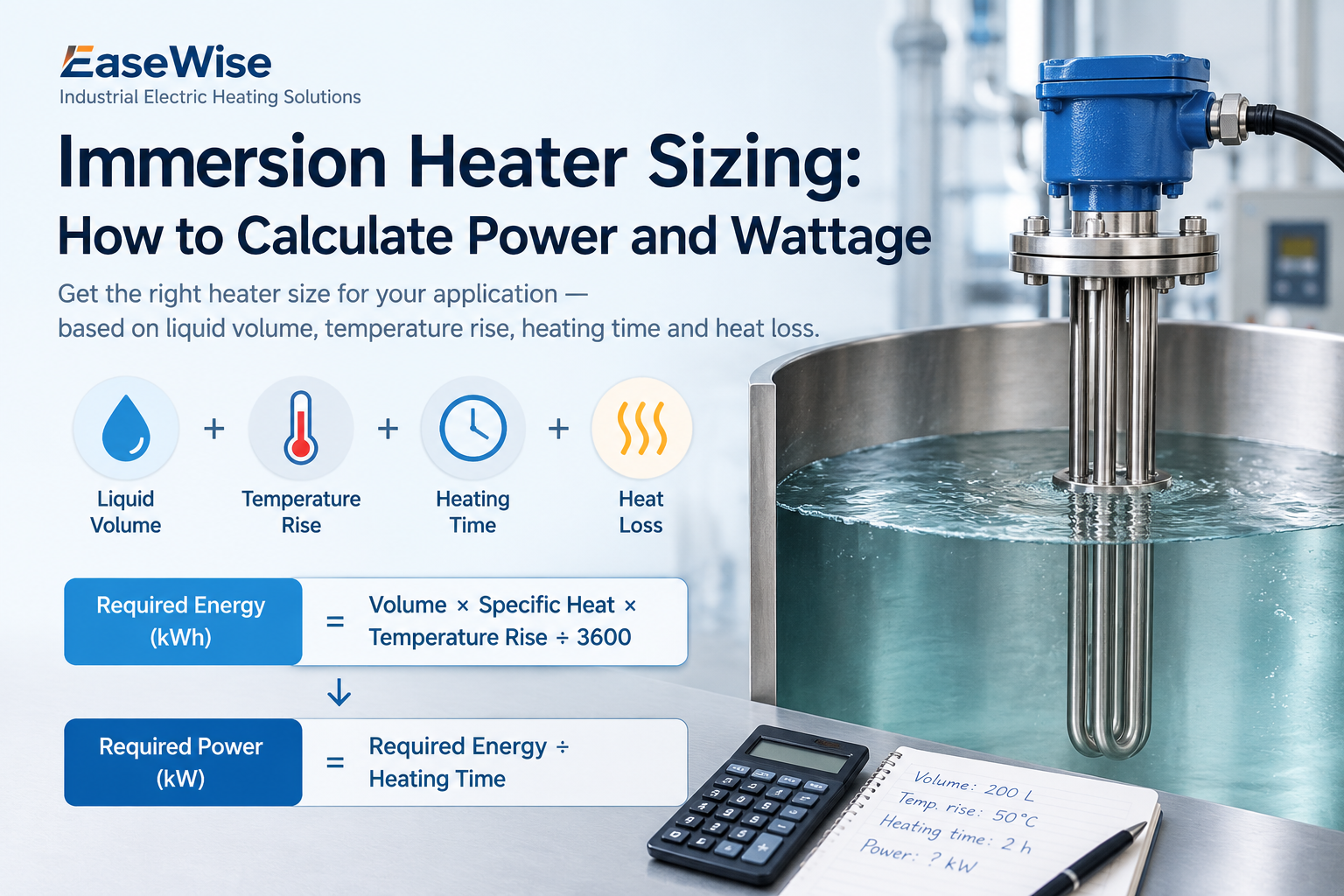
This guide explains how to estimate the required wattage and kW rating for an immersion heater using liquid volume, temperature rise, heating time, and heat loss.
What Information Do You Need for Immersion Heater Sizing?
Before selecting an immersion heater, collect these basic application parameters:
- Liquid volume: How many liters or kilograms of liquid need to be heated?
- Starting temperature: What is the initial liquid temperature?
- Target temperature: What temperature must the liquid reach?
- Heating time: How quickly must the liquid reach the target temperature?
- Liquid type: Water, oil, chemical solution, or another fluid?
- Heat loss: Is the tank insulated, and how much heat is lost to the surrounding environment?
These factors determine the energy required and the heater power needed for the application.
How to Calculate the Required Heating Energy
The first step is to calculate how much energy is required to raise the liquid from its starting temperature to the target temperature.
For water and similar applications, a practical calculation is:
Required Energy (kWh) = Volume (L) × Specific Heat (kJ/kg·°C) × Temperature Rise (°C) ÷ 3600
For water, the specific heat is approximately 4.18 kJ/kg·°C and 1 liter of water is approximately 1 kg.
Example: Heating Water
Suppose you need to heat 100 liters of water from 20°C to 80°C.
The temperature rise is:
80°C − 20°C = 60°C
The required energy is approximately:
100 × 4.18 × 60 ÷ 3600 = 6.97 kWh
So, approximately 6.97 kWh of heating energy is required, before accounting for heat loss.
How to Calculate Immersion Heater Power
Once the required energy is known, you can estimate the heater power based on the required heating time.
Required Heater Power (kW) = Required Energy (kWh) ÷ Heating Time (hours)
For example, if the 100 liters of water above must be heated from 20°C to 80°C in 1 hour:
6.97 kWh ÷ 1 hour = 6.97 kW
The theoretical heater power is therefore approximately 7 kW.
In a real installation, additional power may be required to compensate for heat loss from the tank, piping, heater surface, and surrounding environment.
Allow for Heat Loss When Selecting Heater Wattage
The theoretical calculation assumes that all heater energy goes directly into the liquid. Real systems are different. Heat is continuously lost through the tank walls, pipes, covers, fittings, and surrounding air.
For this reason, the final immersion heater wattage should normally include a suitable allowance for heat loss and operating conditions.
Tank insulation is particularly important. A well-insulated tank can reduce heat loss and allow a lower installed heater power, while an uninsulated tank may require significantly more power to maintain the target temperature.
Immersion Heater Sizing for Different Liquids
The calculation changes when heating liquids other than water because different liquids have different specific heat capacities.
- Water: High specific heat, requiring relatively high energy input for temperature increases.
- Oil: Usually has a lower specific heat than water, but the required power still depends on viscosity, temperature range, circulation, and heat loss.
- Chemical solutions: Specific heat, density, concentration, and material compatibility must be considered.
For non-water applications, provide the liquid type and operating temperature when requesting an immersion heater quotation so the heating element can be selected appropriately.
Choosing the Right Immersion Heater Configuration
Power rating is only one part of immersion heater selection. The heater configuration should also match the tank, liquid, installation method, and operating temperature.
Important selection factors include:
- Required voltage and wattage
- Heater length and heated length
- Sheath material
- Heating element diameter
- Mounting method and thread size
- Liquid compatibility
- Operating temperature
- Watt density
- Temperature control requirements
For industrial applications, EaseWise immersion heaters can be configured according to the required voltage, power, dimensions, mounting arrangement, and application conditions.
Immersion Heater Wattage Example
As a simple reference, consider a 200-liter water tank that needs to be heated from 20°C to 70°C within 2 hours.
The temperature rise is:
70°C − 20°C = 50°C
The theoretical energy requirement is:
200 × 4.18 × 50 ÷ 3600 ≈ 11.61 kWh
The theoretical heater power is:
11.61 kWh ÷ 2 hours ≈ 5.8 kW
Therefore, a heater with approximately 5.8 kW would be the theoretical minimum under ideal conditions. The actual selected rating should account for heat loss and the required operating margin.
Immersion Heater Sizing Checklist
When requesting a quotation, providing the following information helps speed up heater selection:
- Liquid type
- Liquid volume
- Starting temperature
- Target temperature
- Required heating time
- Tank dimensions
- Available voltage
- Required heater mounting method
- Quantity
If you have a tank drawing or existing heater dimensions, you can also provide them for configuration review.
Need a Custom Immersion Heater?
EaseWise supplies industrial electric heating solutions for liquid heating applications. We can help select a suitable immersion heater based on your liquid, volume, temperature range, heating time, voltage, wattage, dimensions, and mounting requirements.
Send us your application requirements for a suitable heater recommendation and quotation.
Amy – Sales
Email: Amy-Easewise@tzheater.com
WhatsApp: +86 188 8318 8154
Hanna – Sales
Email: Hanna-Easewise@tzheater.com
WhatsApp: +86 173 5163 6811