
Thermocouple Troubleshooting: Common Problems, Causes & Solutions
Effective thermocouple troubleshooting helps identify temperature measurement problems before they affect product quality, process stability, or equipment safety. Common issues include no reading, unstable signals, incorrect temperatures, slow response, and gradual measurement drift. This guide explains how to identify the symptoms, check the wiring and measuring instrument, and determine whether a thermocouple needs repair or replacement.
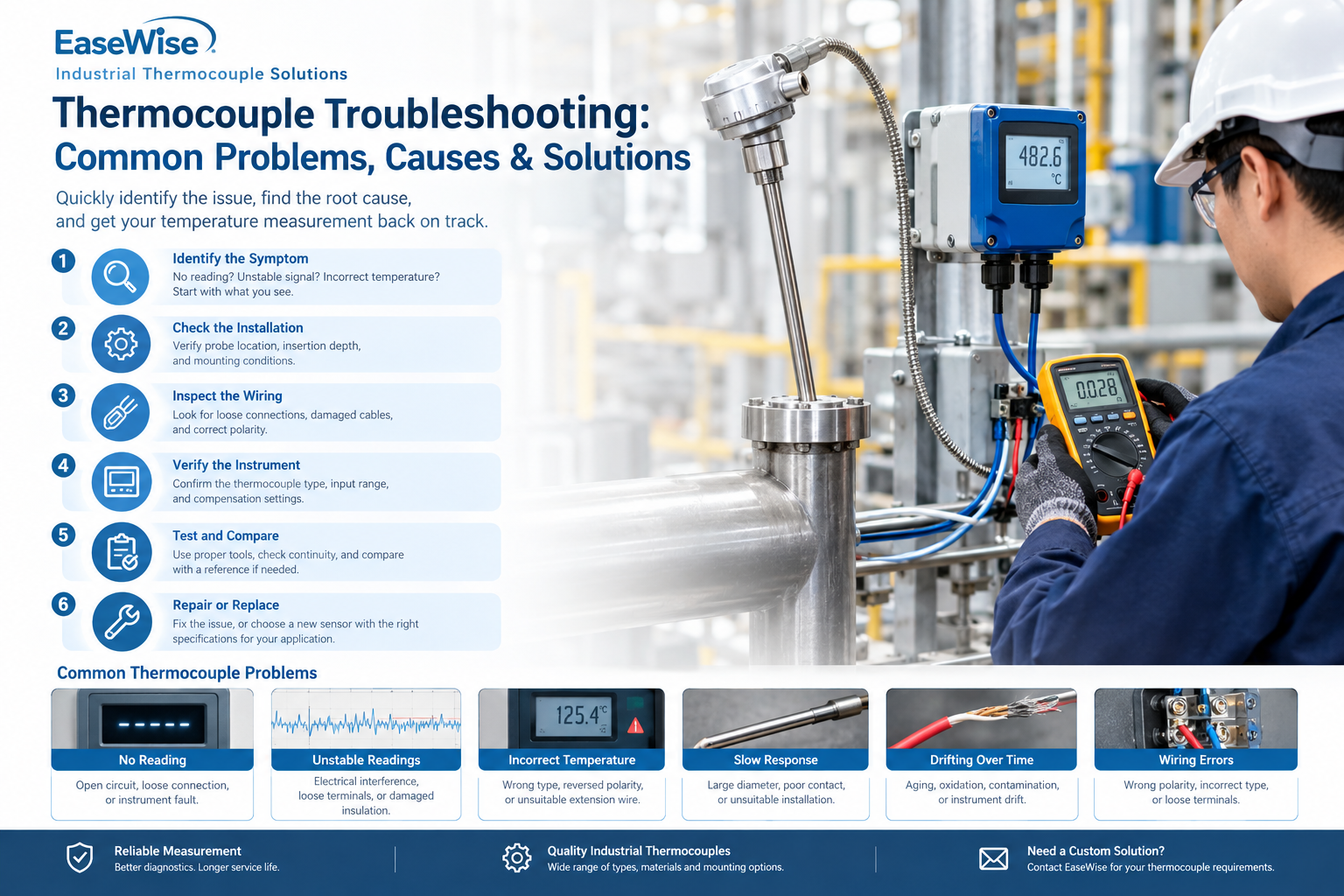
Common Thermocouple Problems and Symptoms
Before starting thermocouple troubleshooting, record the displayed temperature, the actual process conditions, and when the problem occurs. This information can help distinguish a sensor fault from a wiring, installation, or instrument issue.
| Problem | Possible Cause | Recommended Check |
|---|---|---|
| No reading or error message | Open circuit, loose connection, or incorrect input configuration | Inspect the circuit and verify the instrument settings |
| Unstable temperature readings | Loose terminals, electrical interference, or poor grounding | Check connections, cable routing, and grounding |
| Incorrect temperature | Wrong thermocouple type, polarity error, or incorrect calibration | Confirm sensor type, polarity, and measuring range |
| Slow response | Probe too large, poor thermal contact, or unsuitable installation | Review probe dimensions and installation depth |
| Temperature drift | Oxidation, contamination, or long-term high-temperature exposure | Inspect the probe and compare against a reference |
| Reading remains near ambient temperature | Sensor not exposed to the process temperature or a circuit problem | Check probe placement, wiring, and instrument input |
1. Thermocouple Troubleshooting: No Reading or Error Message
If the temperature controller displays an error, an open-circuit alarm, or no temperature value, start by checking the complete measurement circuit.
- Inspect the thermocouple terminals for loose wires, corrosion, or damaged connectors.
- Check the extension cable and connectors for breaks or incorrect connections.
- Confirm that the controller or temperature transmitter is configured for the correct thermocouple type.
- With the equipment safely isolated, test the sensor circuit using an appropriate meter and the manufacturer’s procedure.
Possible solution: Repair loose connections, replace damaged cables, correct the input configuration, or replace a confirmed faulty sensor. Follow the instrument manufacturer’s instructions when testing electrical circuits.
2. Thermocouple Troubleshooting: Unstable or Fluctuating Readings
Fluctuating readings can result from electrical interference, loose connections, grounding problems, or intermittent damage to the sensor cable. These issues are especially relevant when thermocouple wiring runs near motors, variable-frequency drives, or high-current power cables.
- Check terminal blocks and connectors for loose or intermittent contacts.
- Inspect the cable for crushed insulation, moisture, and physical damage.
- Separate thermocouple wiring from high-power cables where practical.
- Verify the grounding and shielding arrangement specified for the measuring system.
- Compare the reading with a suitable independent temperature reference.
Possible solution: Secure the connections, correct cable routing, and replace damaged wiring. Do not change grounding arrangements without checking the equipment manufacturer’s requirements.
3. Thermocouple Troubleshooting: Incorrect Temperature Readings
A thermocouple may produce a stable reading that is still incorrect. Common causes include the wrong sensor type selected in the instrument, reversed polarity, unsuitable extension wire, poor probe placement, or sensor deterioration.
- Confirm that the thermocouple type, such as K, J, T, or another supported type, matches the instrument configuration.
- Check the positive and negative connections against the sensor and instrument documentation.
- Verify that any extension cable is compatible with the thermocouple type.
- Check whether the probe tip is positioned where the process temperature needs to be measured.
- Compare the measurement with a calibrated reference under appropriate test conditions.
Possible solution: Correct the instrument settings, wiring polarity, or probe placement. If the sensor continues to produce inaccurate readings after these checks, investigate calibration requirements or replace the sensor if it has deteriorated.
For help choosing a sensor for your operating conditions, see our industrial thermocouple selection guide.
4. Thermocouple Troubleshooting: Slow Temperature Response
A slow response does not always mean the thermocouple is defective. The probe’s diameter, sheath material, insertion depth, mounting method, and contact with the measured surface can all affect response time.
- Check whether the probe is inserted deeply enough into the measurement area.
- Confirm that the probe tip is exposed to the temperature being measured rather than a cooler surrounding area.
- Review whether the probe diameter and sheath design suit the application.
- Inspect the mounting arrangement for gaps or poor thermal contact.
Possible solution: Improve probe placement or mounting where appropriate. If faster response is essential, consider a suitable smaller-diameter probe or a different construction after reviewing mechanical strength, temperature limits, and process conditions.
5. Thermocouple Troubleshooting: Temperature Drift Over Time
If a thermocouple gradually reports a different temperature under apparently unchanged process conditions, the sensor may have aged or been affected by oxidation, contamination, thermal cycling, or prolonged exposure to high temperatures.
- Inspect the sheath for corrosion, deformation, cracks, or other visible damage.
- Review the process temperature and chemical environment against the sensor’s specifications.
- Compare readings with a suitable reference using a consistent test procedure.
- Review the sensor’s service history and any recent process changes.
Possible solution: Replace a sensor that fails the required accuracy checks. For recurring failures, review the thermocouple type, sheath material, operating temperature, and process compatibility before selecting a replacement.
6. Thermocouple Troubleshooting: Wiring and Installation Errors
Some apparent sensor failures originate from installation mistakes. Incorrect extension wire, reversed polarity, poor connections, or an unsuitable mounting location can affect the measurement even when the thermocouple itself is functional.
- Confirm that the sensor type and extension cable are compatible.
- Check the polarity at both the sensor and instrument terminals.
- Inspect connectors and terminal blocks for corrosion or loose contacts.
- Verify that the probe is installed in the intended measurement location.
- Check that the instrument input settings match the installed sensor.
Correct installation is an important part of reliable temperature measurement. For application-specific guidance, visit our thermocouple applications page.
Step-by-Step Thermocouple Troubleshooting Checklist
- Identify the symptom: Record whether the reading is missing, unstable, inaccurate, slow, or drifting.
- Check the installation: Confirm probe placement, insertion depth, and mounting condition.
- Inspect the wiring: Look for loose terminals, damaged cables, incorrect polarity, and incompatible extension wire.
- Verify the instrument: Confirm the selected thermocouple type, input range, and configuration.
- Test and compare: Follow the manufacturer’s procedure and compare the measurement with an appropriate reference.
- Repair or replace: Correct the identified fault or replace the sensor if it fails the required checks.
Always follow site safety procedures before disconnecting, testing, or replacing a sensor. Industrial equipment may contain hazardous voltages, hot surfaces, pressurized media, or other process hazards.
When Should You Replace a Thermocouple?
Replacement may be appropriate when the probe or cable is physically damaged, the sensor repeatedly fails verification, readings drift beyond acceptable limits, or the existing construction is unsuitable for the operating environment.
Before ordering a replacement, confirm the following information:
- Thermocouple type and required temperature range
- Probe diameter, insertion length, and overall length
- Sheath material and process compatibility
- Mounting method and connection type
- Lead wire, connector, and instrument requirements
You can review our industrial thermocouple products and request a configuration suited to your application.
Frequently Asked Questions About Thermocouple Troubleshooting
Why does my thermocouple show no temperature?
A missing reading may be caused by an open circuit, damaged cable, loose connection, incorrect polarity, or an instrument configured for the wrong sensor type. Check the full measurement circuit before replacing the probe.
Why does my thermocouple reading keep fluctuating?
Common causes include loose connections, electrical interference, grounding issues, and intermittent cable damage. Inspect the wiring and follow the measuring instrument manufacturer’s guidance.
Can a thermocouple become inaccurate over time?
Yes. High-temperature exposure, oxidation, contamination, and repeated thermal cycling can contribute to measurement drift. Compare the sensor with an appropriate reference and replace it if it no longer meets the required accuracy.
Should I replace the thermocouple or the temperature controller?
Do not assume either component has failed. Check the sensor, wiring, input configuration, and measuring instrument systematically. Replace a component only after the relevant checks indicate a fault.
Need Help Selecting a Replacement Thermocouple?
EaseWise supplies industrial temperature sensors for OEM and industrial applications. If you are experiencing recurring thermocouple problems, share your operating temperature, probe dimensions, sheath material, mounting requirements, and application details so our team can help review a suitable configuration.
Request a quote: Submit your thermocouple requirements.
Amy – Sales
Email: amy-EaseWise@tzheater.com
WhatsApp: +86 188 8318 8154
Hanna – Sales
Email: Hanna-EaseWise@tzheater.com
WhatsApp: +86 173 5163 6811