
Cartridge heater failure can lead to production delays, inconsistent heating, damaged equipment, and unexpected maintenance costs. Understanding common cartridge heater problems helps you identify faults, improve heating performance, and reduce premature replacement. This guide explains how to troubleshoot cartridge heater issues, including no heat, overheating, short circuits, and repeated burnout.
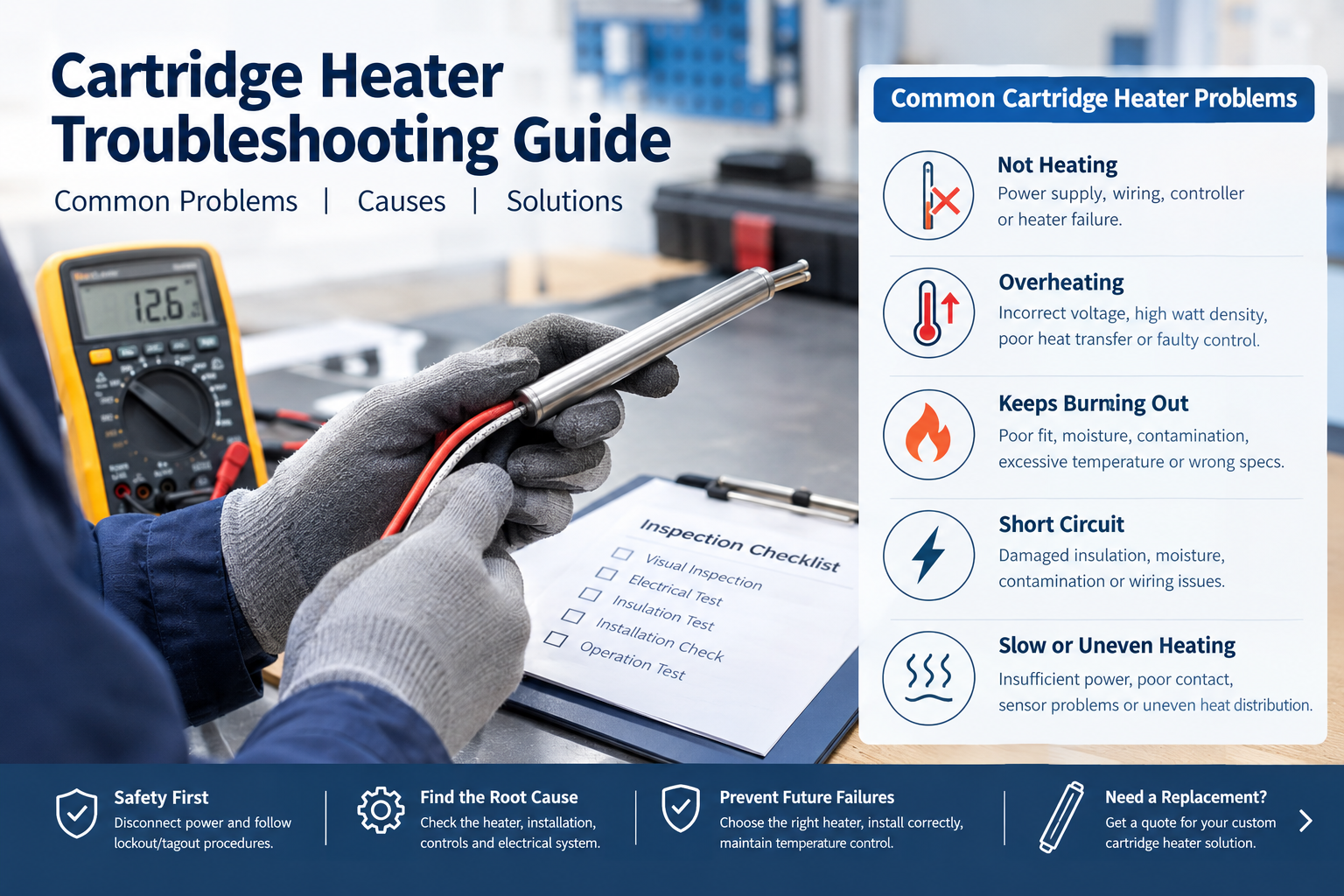
Common Cartridge Heater Failure Symptoms and Causes
Before replacing a heating element, identify the symptoms and inspect the surrounding equipment. Cartridge heater failure may result from electrical faults, unsuitable operating conditions, poor heat transfer, or incorrect installation.
| Problem | Possible Cause | Recommended Check |
|---|---|---|
| Cartridge heater not heating | Power supply failure, damaged wiring, or an open heating circuit | Check supply voltage, connections, and heater resistance. |
| Cartridge heater overheating | Poor heat transfer, excessive watt density, or temperature-control problems | Inspect the bore fit, sensor, and controller settings. |
| Repeated heater burnout | Excessive operating temperature, moisture, or unsuitable heater specifications | Review operating conditions, installation, and heater ratings. |
| Short circuit or electrical tripping | Damaged insulation, moisture ingress, or wiring faults | Disconnect power and arrange electrical testing. |
| Slow or uneven heating | Incorrect wattage, poor contact, or uneven temperature distribution | Check heater sizing, bore dimensions, and process requirements. |
Cartridge Heater Failure: No Heating
A cartridge heater that does not produce heat may have a power supply issue, a damaged connection, or a failed internal heating element. Check the external electrical system before concluding that the heater itself has failed.
How to Troubleshoot a Cartridge Heater with No Heat
- Verify that the power supply and control system are operating correctly.
- Inspect accessible wiring, terminals, and connectors for visible damage.
- Disconnect power and isolate the heater before measuring its resistance.
- Compare the measured resistance with the expected value based on rated voltage and wattage.
- If the circuit is open or the result is inconsistent with specifications, have the heater and wiring assessed by a qualified technician.
For a resistive heater, approximate resistance can be calculated using:
Resistance (Ω) = Voltage² ÷ Rated Power (W)
For example, a nominal 220 V, 500 W heater has an approximate resistance of 96.8 Ω. Actual readings may vary because of manufacturing tolerances, temperature, and measurement conditions. Always refer to the manufacturer’s specifications.
Cartridge Heater Failure: Overheating
Cartridge heater overheating may damage the heating element, surrounding components, or the material being heated. Common causes include poor heat transfer, excessive watt density, inadequate temperature control, or operation outside the heater’s rated conditions.
Common Causes of Cartridge Heater Overheating
- Poor bore fit: An oversized hole or poor contact can reduce heat transfer to the surrounding metal.
- Excessive watt density: The heater may generate heat faster than the application can dissipate it.
- Temperature-control problems: A faulty sensor, incorrect sensor position, or controller malfunction may cause excessive temperatures.
- Insufficient heat dissipation: The application may not transfer heat away from the heater effectively.
To reduce overheating risk, verify bore dimensions, insertion depth, watt density, operating temperature, and the temperature-control system. Select the heater according to the application rather than wattage alone.
Cartridge Heater Failure: Repeated Burnout
Repeated cartridge heater failure usually indicates that an underlying operating or installation problem has not been resolved. Replacing the heater without investigating the cause may lead to another failure.
What to Check Before Replacing the Heater
- Operating temperature: Confirm that the heater and lead-wire ratings suit the application.
- Watt density: Check whether heat output is appropriate for the heated material and available heat-transfer area.
- Installation conditions: Inspect the bore, insertion depth, and mechanical fit.
- Electrical conditions: Confirm that the supply voltage matches the heater rating.
- Moisture and contamination: Check for exposure to moisture, oil, chemicals, or other contaminants.
- Switching frequency: Review control cycles and operating conditions if the heater repeatedly switches on and off.
Record the failure pattern, operating temperature, supply voltage, and time to failure. These details help determine whether a different wattage, construction, sheath material, or lead configuration is required.
Cartridge Heater Electrical Failure: Short Circuits
A short circuit, ground fault, or unexpected circuit-breaker trip may indicate damaged wiring, deteriorated insulation, moisture ingress, or a problem elsewhere in the electrical system.
Electrical Inspection Steps
- Switch off and isolate the power supply before inspecting the heater or wiring.
- Check accessible cables, terminals, and connectors for burns, cuts, loose connections, or other visible damage.
- Have a qualified technician test heater resistance and insulation resistance using appropriate equipment.
- Compare results with the manufacturer’s requirements and applicable electrical safety standards.
Do not continue operating a heater that repeatedly trips protection devices or shows signs of insulation damage. Never measure resistance on an energized circuit. Follow equipment instructions when preparing a heater for insulation testing.
Slow or Uneven Cartridge Heater Heating
Slow heating does not always mean that the cartridge heater has failed. The heater may be undersized, poorly fitted, incorrectly positioned, or unsuitable for the thermal load.
How to Improve Cartridge Heater Performance
- Confirm the required heating time and total thermal load.
- Check that rated voltage and wattage match application requirements.
- Verify the hole diameter, insertion depth, and contact between the heater and surrounding material.
- Check sensor location and temperature distribution across the heated component.
- Review whether heater dimensions, watt density, and construction suit the application.
Increasing wattage is not always the right solution. An oversized heater may create localized hot spots or shorten service life if the application cannot dissipate the additional heat.
Cartridge Heater Failure Troubleshooting Checklist
Use this checklist to organize an initial inspection. Electrical testing and repairs should be performed by qualified personnel using appropriate procedures and equipment.
| Inspection Item | What to Verify |
|---|---|
| Power supply | Rated voltage, supply stability, and control output |
| Heater resistance | Measured resistance compared with the expected value and tolerance |
| Insulation condition | Insulation resistance and signs of electrical damage |
| Mechanical installation | Bore size, fit, insertion depth, and mounting condition |
| Temperature control | Sensor placement, controller settings, and actual operating temperature |
| Heater specifications | Voltage, wattage, dimensions, sheath material, and lead-wire ratings |
How to Prevent Cartridge Heater Failure
Preventive measures can help reduce downtime and improve heater service life. The right approach depends on the material being heated, operating temperature, installation design, and duty cycle.
- Choose heater wattage and watt density based on the application’s thermal requirements.
- Specify suitable dimensions and bore tolerances to support effective heat transfer.
- Use a compatible temperature sensor and properly configured temperature controller.
- Protect electrical connections from moisture, contamination, and mechanical damage.
- Inspect heaters and wiring periodically according to equipment maintenance guidance.
- Provide accurate drawings and operating specifications when ordering a replacement heater.
When to Replace a Failed Cartridge Heater
Replacement may be necessary when the heater has an open circuit, confirmed insulation damage, physical deformation, or performance that cannot be restored safely. Before installing a new heater, identify the likely cause of the original failure to help avoid a repeat problem.
Review our custom cartridge heater solutions to learn more about available options. The correct selection depends on required dimensions, voltage, wattage, operating temperature, installation conditions, and lead-wire configuration.
Frequently Asked Questions
Why Does My Cartridge Heater Stop Working?
Common causes include an interrupted power supply, damaged wiring, an open heating element, overheating, moisture ingress, or unsuitable operating conditions. Check the power and control system before determining whether the heater needs replacement.
Can a Cartridge Heater Be Repaired?
In many cases, a failed sealed cartridge heater is replaced rather than repaired. External wiring or control-system problems may be repairable, but a damaged heater should be evaluated against the manufacturer’s guidance and applicable safety requirements.
How Can I Tell If a Cartridge Heater Has Burned Out?
Symptoms may include no heat, an open-circuit resistance reading, visible damage, or a failed insulation test. Disconnect power and isolate the heater before testing. A qualified technician should assess uncertain or unsafe conditions.
What Information Is Needed to Replace a Cartridge Heater?
Provide the heater diameter and length, rated voltage, wattage, lead-wire type and length, operating temperature, quantity, and application details. A PDF or DXF drawing is useful for custom designs.
Need Help with Cartridge Heater Failure?
EaseWise supplies custom industrial heating solutions based on application requirements. If your cartridge heater is overheating, failing repeatedly, or not heating correctly, share the heater specifications and operating conditions so our team can help review your requirements.
For a quotation, please provide your PDF or DXF drawing, voltage, wattage, and required quantity.
Amy – Sales
Email: amy-EaseWise@tzheater.com
WhatsApp: +86 188 8318 8154
Hanna – Sales
Email: Hanna-EaseWise@tzheater.com
WhatsApp: +86 173 5163 6811