
Thermocouple Voltage and mV Output Explained
A thermocouple measures temperature by generating a small electrical voltage when its measuring junction and reference junction are at different temperatures. This signal is usually measured in millivolts (mV) and converted into a temperature reading by a compatible instrument.
Understanding thermocouple voltage helps engineers troubleshoot temperature readings, select compatible measurement instruments, and identify potential wiring or configuration problems in industrial temperature measurement systems.
What Is Thermocouple Voltage?
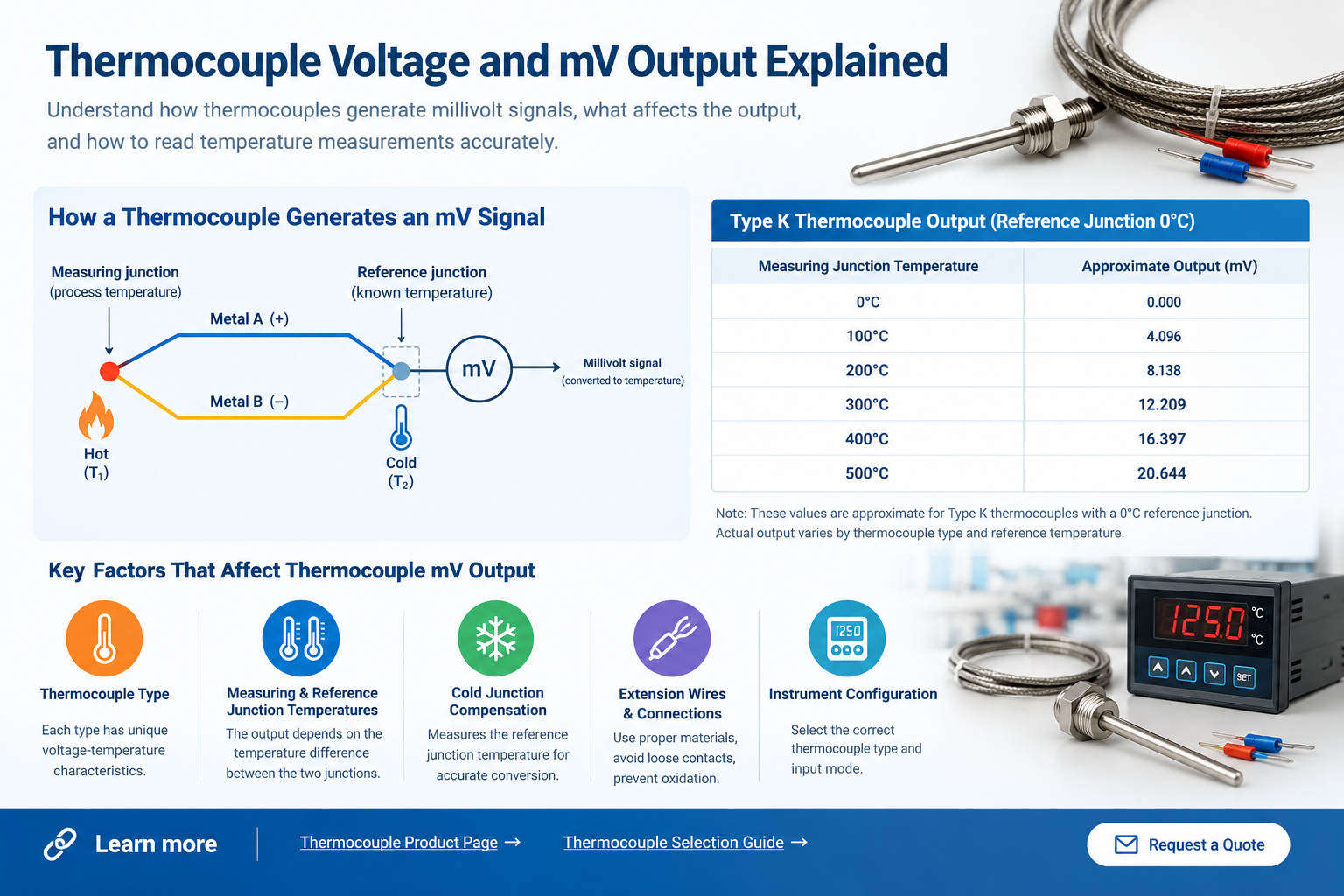
Thermocouple voltage is the small electromotive force (EMF) produced by the thermoelectric properties of two dissimilar conductors. When the measuring junction and reference junction are at different temperatures, a voltage develops in the circuit. This behavior is known as the Seebeck effect.
The generated signal depends on the thermocouple type, the temperature difference between the junctions, and the thermoelectric characteristics of the conductor materials. A thermocouple does not generate one fixed voltage for every temperature.
Because the output is small, thermocouple signals are commonly expressed in millivolts rather than volts.
- mV: Millivolts, a unit of electrical voltage.
- EMF: Electromotive force generated by the thermoelectric circuit.
- Measuring junction: The junction positioned to measure the process temperature.
- Reference junction: The reference point used when interpreting the thermocouple voltage.
How Does a Thermocouple Generate an mV Signal?
A thermocouple uses two different thermoelectric conductors connected to form a measurement circuit. When the measuring junction is at a different temperature from the reference junction, the circuit produces a measurable voltage.
- The measuring junction is exposed to the temperature being monitored.
- The reference junction has its own temperature, which must be known or measured.
- The temperature difference produces a thermoelectric voltage.
- A compatible meter, transmitter, or temperature controller measures the voltage and converts it into a temperature value using the selected thermocouple type.
The relationship between voltage and temperature is nonlinear. Therefore, the instrument must use the correct thermocouple type and its corresponding voltage-temperature characteristics to calculate temperature accurately.
Thermocouple Voltage vs. Temperature
Thermocouple output generally changes as the measuring junction temperature changes relative to the reference junction. However, the exact voltage depends on the thermocouple type and reference temperature.
The following table shows approximate Type K thermocouple EMF values when the reference junction is maintained at 0°C.
| Measuring Junction Temperature | Approximate Type K Output |
|---|---|
| 0°C | 0.000 mV |
| 100°C | 4.096 mV |
| 200°C | 8.138 mV |
| 300°C | 12.209 mV |
| 400°C | 16.397 mV |
| 500°C | 20.644 mV |
Important: These approximate values apply to Type K thermocouples with a 0°C reference junction. If the reference junction is at room temperature, the measured voltage will differ. For actual measurement and calibration, use the applicable standardized reference tables or a compatible instrument.
What Factors Affect Thermocouple mV Output?
1. Thermocouple Type
Different thermocouple types use different conductor materials and have different voltage-temperature characteristics. Type K, J, T, E, N, R, S, and B thermocouples cannot be interpreted using the same conversion table.
Always confirm the sensor type before configuring a temperature controller, transmitter, or measuring instrument.
2. Measuring and Reference Junction Temperatures
The output depends on the temperatures of the two junctions. A voltage reading cannot be converted into an accurate measuring-junction temperature unless the reference-junction temperature is known or properly compensated.
3. Cold Junction Compensation
Modern thermocouple instruments commonly use cold junction compensation (CJC). The instrument measures the temperature at the reference connection and uses that information with the measured thermocouple voltage to calculate the measuring-junction temperature.
If cold junction compensation is disabled, incorrectly configured, or affected by installation problems, the displayed temperature may be inaccurate even when the thermocouple itself is functioning.
4. Extension Wires and Electrical Connections
Incorrect extension wire, unsuitable connector materials, loose terminals, oxidation, or unintended temperature gradients at connections can introduce measurement errors. Use extension or compensation wire appropriate for the thermocouple type and follow the instrument manufacturer’s wiring instructions.
5. Instrument Configuration
A temperature controller or meter must be configured for the correct thermocouple type and input mode. An incorrect sensor setting, incompatible input, or unsuitable measurement range can result in incorrect temperature readings.
How to Measure Thermocouple Voltage
A compatible millivolt meter or thermocouple instrument can be used to measure thermocouple output. For reliable results, check the following before testing:
- Identify the thermocouple type and verify the instrument’s input compatibility.
- Check the polarity and terminal connections against the manufacturer’s wiring diagram.
- Use suitable thermocouple extension wire where required.
- Record the measuring-junction and reference-junction conditions.
- Compare the measured voltage with the appropriate reference data, accounting for reference-junction temperature.
- For troubleshooting, check connections, instrument configuration, sensor condition, and possible electrical interference.
A raw mV reading alone does not establish the exact process temperature. Correct interpretation requires the thermocouple type and reference-junction information.
Common Thermocouple Voltage Problems
| Observed Problem | Possible Cause | What to Check |
|---|---|---|
| No signal or an open-circuit indication | Broken thermocouple wire, loose terminal, or disconnected sensor | Inspect wiring continuity and terminal connections using an appropriate procedure. |
| Unexpected temperature reading | Wrong thermocouple type, reversed polarity, or incorrect input configuration | Verify the sensor type, wiring, and instrument settings. |
| Unstable readings | Loose connections, electrical interference, grounding issues, or an unstable process | Inspect connections, cable routing, grounding arrangements, and the measurement environment. |
| Consistent measurement offset | Reference-junction compensation error, calibration issue, or installation-related temperature error | Check cold junction compensation, instrument calibration, and sensor placement. |
Always follow the equipment manufacturer’s electrical safety instructions before testing or disconnecting a sensor in an operating industrial system.
How to Select a Thermocouple for Reliable Measurement
Thermocouple signal quality depends on more than the sensor’s nominal output. Select a suitable sensor and measurement setup based on the operating temperature, thermocouple type, probe dimensions, installation method, cable requirements, and compatible instrument.
For help comparing thermocouple types and installation configurations, see our Thermocouple Selection Guide.
For industrial temperature measurement products and available configurations, visit our Industrial Thermocouples product page.
Frequently Asked Questions
What is the output voltage of a thermocouple?
A thermocouple produces a small voltage, usually measured in millivolts. Its output depends on the thermocouple type and the temperatures of the measuring and reference junctions.
How many millivolts does a Type K thermocouple produce at 100°C?
With a 0°C reference junction, a Type K thermocouple produces approximately 4.096 mV at a measuring-junction temperature of 100°C. A different reference-junction temperature changes the measured voltage.
Can thermocouple voltage be converted directly into temperature?
Yes, when the thermocouple type is known and the reference-junction temperature is accounted for. A compatible instrument uses the appropriate voltage-temperature relationship to calculate the temperature.
Why does a thermocouple produce a negative voltage?
A negative reading can occur when the measurement polarity is reversed or when the measuring junction is at a lower temperature than the reference junction, depending on the wiring and measurement convention. Check the thermocouple type, polarity, and actual temperature conditions before diagnosing the sensor.
Does every thermocouple have the same mV output?
No. Different thermocouple types have different thermoelectric characteristics. The correct reference data and instrument configuration must match the sensor type.
Need an Industrial Thermocouple?
EaseWise supplies industrial thermocouples for temperature measurement and process control applications. We can discuss thermocouple type, probe diameter, insertion length, sheath material, mounting method, cable, connector, and other configuration requirements.
To request a quotation, please share your application, required temperature range, thermocouple type, probe dimensions, connection requirements, and quantity.
Amy – Sales
Email: amy-EaseWise@tzheater.com
WhatsApp: +86 188 8318 8154
Hanna – Sales
Email: Hanna-EaseWise@tzheater.com
WhatsApp: +86 173 5163 6811