
Choosing between a tubular heater and a cartridge heater depends on the installation space, heating method, operating conditions, and required heat transfer. Although both are widely used in industrial heating equipment, their structures and typical applications are different. This guide compares a tubular heater vs cartridge heater to help equipment manufacturers, engineers, and buyers select a suitable heating element.
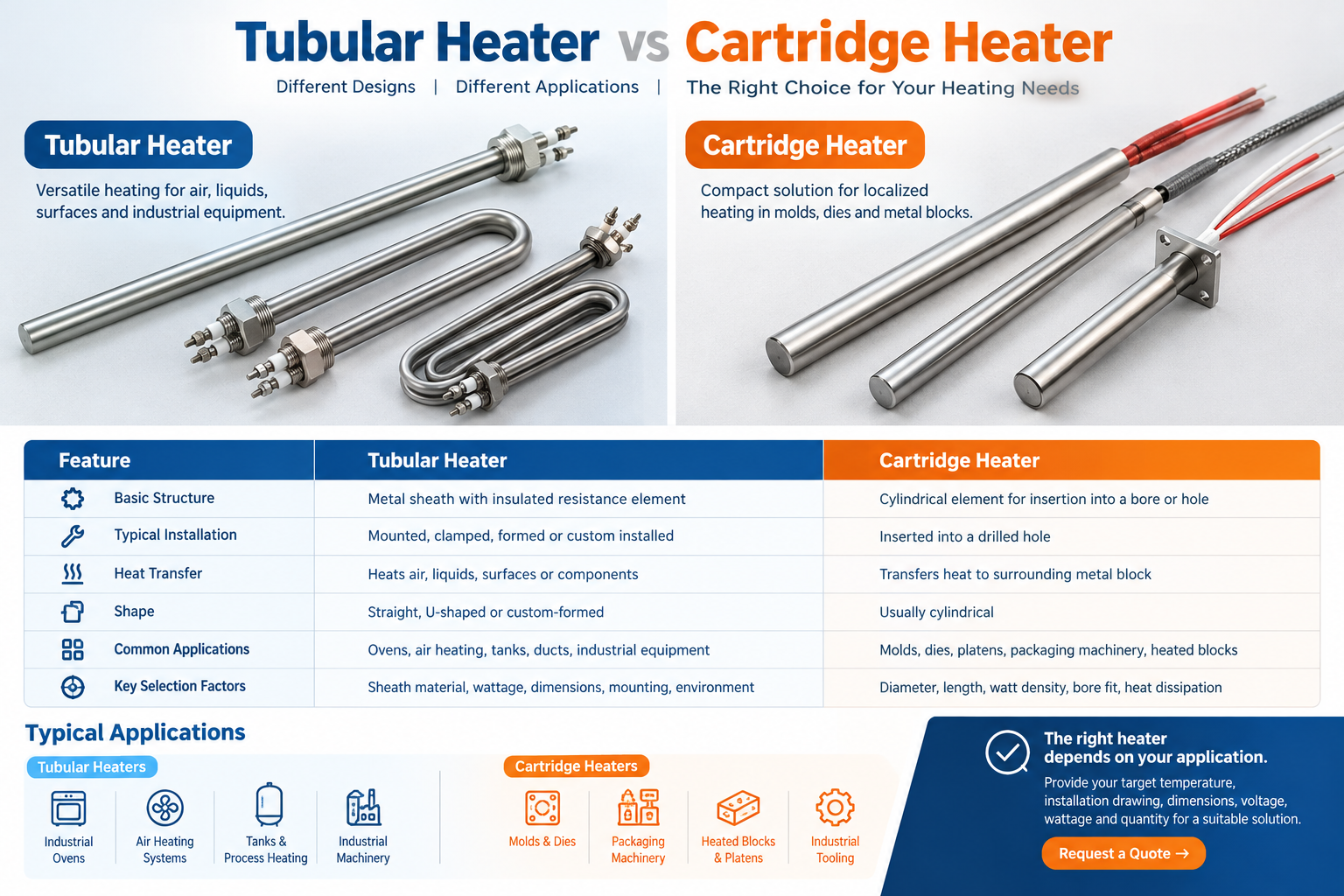
Tubular Heater vs Cartridge Heater: Key Differences
| Comparison | Tubular Heater | Cartridge Heater |
|---|---|---|
| Basic Structure | Metal sheath containing an insulated resistance heating element | Cylindrical heating element designed for insertion into a bore or hole |
| Typical Installation | Mounted, clamped, formed, or installed according to the application | Inserted into a correctly sized drilled hole |
| Heat Transfer | Can heat air, liquids, surfaces, or metal components depending on design | Primarily transfers heat to a surrounding metal block or component |
| Shape | Straight, U-shaped, or custom-formed configurations | Usually cylindrical, with selected diameters and lengths |
| Common Applications | Ovens, air heating, tanks, ducts, and industrial equipment | Molds, dies, platens, packaging machinery, and heated blocks |
| Key Selection Factors | Sheath material, wattage, dimensions, mounting, and environment | Diameter, length, watt density, bore fit, and heat dissipation |
Actual performance depends on heater construction, material, wattage, operating temperature, installation, and the surrounding heat-transfer conditions. Neither heater type is automatically better for every application.
What Is a Tubular Heater?
A tubular heater is an electric resistance heating element enclosed in a metal sheath. Its shape and mounting arrangement can be adapted to different heating requirements. Tubular heaters are commonly used for heating air, liquids, metal surfaces, and process equipment when designed for the intended environment.
Advantages of Tubular Heaters
- Available in straight, U-shaped, and other formed configurations.
- Can be designed for air heating, liquid heating, or surface heating.
- Offer flexible mounting options for industrial equipment.
- Can be customized by dimensions, wattage, voltage, and sheath material.
Typical Tubular Heater Applications
- Industrial ovens and drying systems
- Air ducts and forced-air heating equipment
- Liquid tanks and process heating systems
- Industrial machinery and custom heating assemblies
Explore our tubular heater range for industrial heating applications and custom configurations.
What Is a Cartridge Heater?
A cartridge heater is a compact cylindrical electric heating element designed to fit into a drilled hole in a metal component. It is frequently used where heat must be delivered to a specific area, such as a mold, die, heated platen, or metal block.
Advantages of Cartridge Heaters
- Compact construction for localized heating.
- Suitable for installation in appropriately machined holes.
- Available in different diameters, lengths, voltages, and wattages.
- Can be specified for tooling and machinery requiring controlled heat.
Typical Cartridge Heater Applications
- Injection molds and dies
- Packaging and sealing machinery
- Heated metal blocks and platens
- Industrial tooling and process equipment
See our cartridge heater product page for product information and customization options.
How to Choose: Tubular Heater vs Cartridge Heater
1. Consider the Installation Method
Choose a cartridge heater when the equipment has a suitable drilled hole and requires a compact heater inserted into a metal component. A tubular heater may be more appropriate when the design requires a formed element, surface mounting, or a heating element positioned in air or liquid.
2. Evaluate the Heat-Transfer Requirements
Consider what needs to be heated and how heat moves from the element to the target. Cartridge heaters commonly transfer heat through close contact with a surrounding metal bore. Tubular heaters can support several heat transfer arrangements depending on their design and installation.
3. Check Wattage and Watt Density
Required wattage depends on the mass of the material, target temperature, heat loss, warm-up time, and operating conditions. For cartridge heaters, watt density and bore fit are particularly important because poor contact or insufficient heat dissipation can cause overheating and shorten heater life. Tubular heaters also require suitable watt loading and heat-transfer conditions.
4. Match Materials to the Operating Environment
Select sheath materials, insulation, terminals, and seals according to the operating temperature and exposure to moisture, chemicals, or other environmental conditions. Confirm the heater specification with the supplier before ordering.
5. Confirm Electrical and Dimensional Specifications
Before choosing a heater, confirm the supply voltage, wattage, dimensions, mounting method, lead or terminal arrangement, temperature requirements, and available installation space.
Tubular Heater vs Cartridge Heater: Which Is Better?
A tubular heater is often a suitable choice for air heating, liquid heating, formed heating elements, and applications requiring flexible mounting arrangements. A cartridge heater is often a better fit for localized heating inside molds, dies, and metal blocks with properly designed mounting holes.
The right option depends on the application rather than the heater name alone. If you are unsure which design to select, provide the target temperature, installation drawing, dimensions, voltage, wattage, and quantity so the required configuration can be evaluated.
Request a Custom Industrial Heater
EaseWise supports industrial heating requirements with product sourcing, technical consultation, quality inspection, and OEM customization. Share your drawing or specifications to discuss a suitable tubular heater or cartridge heater for your equipment.
Contact EaseWise
Amy – Sales
Email:
amy-EaseWise@tzheater.com
WhatsApp:
+86 188 8318 8154
Hanna – Sales
Email:
Hanna-EaseWise@tzheater.com
WhatsApp:
+86 173 5163 6811
Send your DXF or PDF drawing, voltage, wattage, and required quantity for a quotation. Our sales team aims to reply within 12 hours.