
Thermocouple Accuracy: What Affects Measurement Accuracy?
Thermocouple accuracy determines how closely a measured temperature represents the actual temperature at the measurement point. In industrial applications, measurement accuracy depends not only on the thermocouple itself, but also on sensor type, calibration, installation, the measuring instrument, and operating conditions.
Understanding these factors helps engineers select the right thermocouple, reduce measurement errors, and maintain reliable temperature control in industrial equipment.
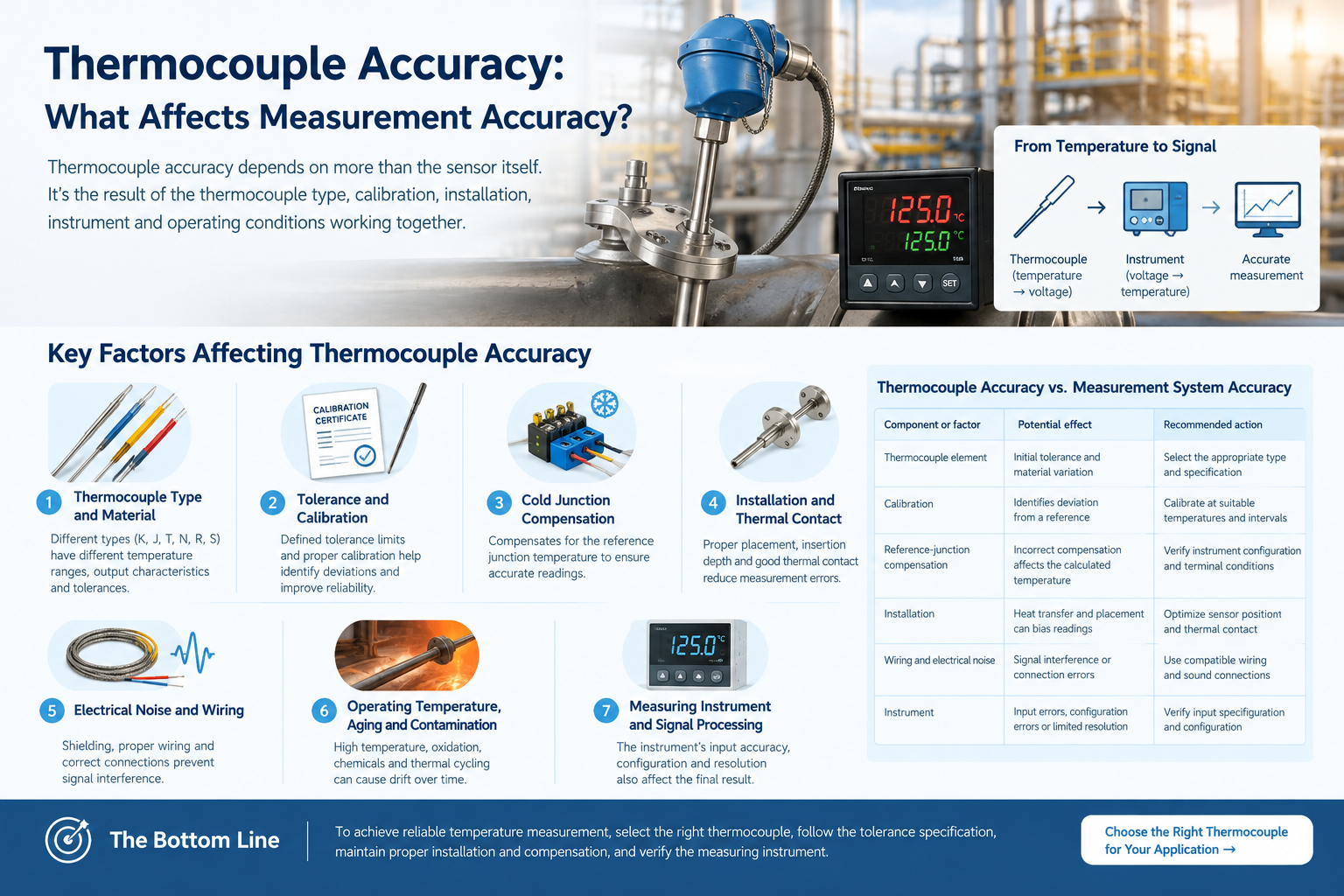
What Is Thermocouple Accuracy?
Thermocouple accuracy describes how close a temperature measurement is to the true or accepted reference temperature. A thermocouple generates a small voltage in response to the temperature difference between its measuring junction and reference junction. An instrument converts this voltage into a temperature reading.
Errors can occur at several stages, including the sensor, electrical connections, reference-junction compensation, signal processing, and installation.
Three terms are important when evaluating thermocouple performance:
- Accuracy: How close a measurement is to the accepted reference value.
- Tolerance: The permitted deviation specified for a thermocouple under defined conditions.
- Measurement uncertainty: The quantified doubt associated with a measurement result, considering relevant sources of variation and error.
These terms are related, but they are not interchangeable. A sensor’s specified tolerance does not automatically represent the accuracy of the complete temperature measurement system.
What Factors Affect Thermocouple Accuracy?
1. Thermocouple Type and Material
Different thermocouple types use different combinations of metal alloys. Their temperature ranges, output characteristics, stability, and specified tolerances vary.
- Type K: Commonly used for general industrial temperature measurement over a broad temperature range.
- Type J: Used in various industrial processes where its material characteristics and operating range are suitable.
- Type T: Often selected for lower-temperature measurements and applications requiring suitable low-temperature performance.
- Type N: Used in industrial applications where its performance characteristics are appropriate, including some elevated-temperature environments.
- Types R and S: Noble-metal thermocouples used in high-temperature applications that require suitable materials and measurement performance.
Choosing a thermocouple type solely by its maximum temperature rating is not sufficient. The required accuracy, operating environment, sensor construction, and applicable specification should also be considered.
2. Thermocouple Tolerance and Calibration
A thermocouple manufactured to a recognized specification has defined tolerance limits over specified temperature ranges. For example, IEC 60584-1 specifies thermocouple electromotive-force characteristics and tolerance classes for applicable thermocouple types.
These tolerances apply under the conditions defined by the relevant specification. They should not be interpreted as a guarantee of the complete installed system’s measurement accuracy.
Calibration compares the thermocouple’s response with a suitable reference and helps identify deviations. Depending on the application, calibration may be performed at one or more temperatures across the required operating range.
Calibration is particularly important when measurement results affect product quality, process control, safety limits, or compliance requirements. Calibration intervals should be based on application risk, operating conditions, historical drift, and quality-system requirements.
3. Cold Junction Compensation
A thermocouple measures the temperature difference between its measuring junction and reference junction. The measuring instrument therefore needs to account for the reference-junction temperature to calculate the measuring-junction temperature.
This process is commonly called cold junction compensation or reference-junction compensation.
If the compensation sensor is inaccurate, the terminal temperature changes unexpectedly, or the instrument’s compensation method is unsuitable, the displayed temperature may deviate from the actual temperature.
To reduce related errors, use a compatible instrument, ensure proper terminal connections, and follow the instrument manufacturer’s installation and compensation instructions.
4. Sensor Installation and Thermal Contact
Even a thermocouple with suitable specifications can produce misleading readings if it is installed incorrectly.
Common installation-related issues include:
- Poor thermal contact between the sensor and the measured surface.
- Incorrect insertion depth in a pipe, furnace, or process vessel.
- Heat loss along the probe or thermowell.
- Heat transfer from nearby equipment or the surrounding environment.
- Placement in a location that does not represent the actual process temperature.
For example, a surface-mounted thermocouple may respond differently from an immersed probe because of contact resistance and heat transfer to the surrounding air. Selecting an appropriate probe design and installation method helps improve measurement reliability.
5. Electrical Noise and Wiring
Thermocouples generate low-level electrical signals, making their readings susceptible to electrical interference and wiring errors.
Potential causes include electromagnetic interference from motors or variable-frequency drives, loose terminals, damaged wires, incorrect extension cables, and unintended connections between dissimilar metals.
Use extension or compensation cables compatible with the thermocouple type. Keep sensor wiring appropriately separated from power cables, maintain sound electrical connections, and follow the instrument manufacturer’s grounding and shielding recommendations.
6. Operating Temperature, Aging, and Contamination
Long-term exposure to high temperatures, oxidation, chemical contamination, mechanical stress, and repeated thermal cycling can change thermocouple properties.
These changes may cause calibration drift even when the sensor initially met its specified tolerance. Protective sheaths and suitable probe materials can help reduce environmental damage, but the correct design depends on the process atmosphere, temperature, pressure, and chemical exposure.
For demanding applications, inspect sensors periodically and replace them when damage, instability, or unacceptable drift is identified.
7. Measuring Instrument and Signal Processing
The thermocouple is only one part of the measurement system. The connected temperature controller, transmitter, data acquisition module, or digital thermometer also contributes to the overall measurement result.
Check that the instrument is configured for the correct thermocouple type, supports the required temperature range, and has suitable input accuracy and resolution. Incorrect sensor-type settings can produce substantial errors even when the probe itself is functioning correctly.
Thermocouple Accuracy vs. Measurement System Accuracy
When evaluating a temperature measurement, distinguish the sensor’s specified performance from the performance of the complete system.
| Component or factor | Potential effect | Recommended action |
|---|---|---|
| Thermocouple element | Initial tolerance and material variation | Select the appropriate type and specification |
| Calibration | Identifies deviation from a reference | Calibrate at suitable temperatures and intervals |
| Reference-junction compensation | Incorrect compensation affects the calculated temperature | Verify instrument configuration and terminal conditions |
| Installation | Heat transfer and placement can bias readings | Optimize sensor position and thermal contact |
| Wiring and electrical noise | Signal interference or connection errors | Use compatible wiring and sound connections |
| Instrument | Input errors, configuration errors, or limited resolution | Verify input specifications and configuration |
The overall measurement uncertainty should be evaluated using the relevant uncertainty contributions and their relationships. Simply adding every error limit together may not provide a valid uncertainty estimate.
How to Improve Thermocouple Accuracy
For more reliable industrial temperature measurements, follow these practical steps:
- Define the measurement requirement. Establish the operating temperature range, acceptable deviation, response time, and process conditions.
- Select the appropriate thermocouple type. Match the sensor material and specification to the application.
- Choose a suitable probe construction. Consider the sheath material, probe diameter, insertion length, junction design, and environmental exposure.
- Verify instrument compatibility. Confirm the sensor type, reference-junction compensation, input range, and configuration.
- Install the sensor correctly. Ensure representative placement, suitable thermal contact, and appropriate wiring.
- Calibrate and monitor performance. Use a suitable reference and establish an interval based on operating conditions and measurement requirements.
- Inspect the complete measurement loop. When readings appear incorrect, check the probe, wiring, connections, instrument, and installation before replacing components.
How to Choose a Thermocouple for Your Application
The best thermocouple is not necessarily the one with the tightest nominal tolerance. It is the sensor that meets the application’s measurement requirements under real operating conditions.
Before selecting a thermocouple, consider:
- Required temperature range and acceptable measurement deviation.
- Thermocouple type and applicable tolerance specification.
- Probe dimensions, junction construction, and response time.
- Process atmosphere, pressure, vibration, and chemical exposure.
- Compatible extension wiring and temperature measurement instrument.
- Calibration, traceability, and documentation requirements.
For industrial temperature sensing options, see our Industrial Thermocouples product page.
Frequently Asked Questions
What is the accuracy of a thermocouple?
Thermocouple accuracy depends on the thermocouple type, applicable tolerance class, temperature, calibration condition, installation, and measuring instrument. Check the specification for the exact sensor and operating conditions rather than assuming that every thermocouple has the same accuracy.
Does a more expensive thermocouple always provide better accuracy?
No. Price alone does not determine measurement accuracy. Material selection, manufacturing quality, calibration, probe construction, instrument compatibility, and installation all affect performance.
How often should a thermocouple be calibrated?
There is no single calibration interval suitable for every application. The interval depends on operating temperature, environmental exposure, required measurement reliability, historical drift, and applicable quality requirements.
Can installation affect thermocouple accuracy?
Yes. Incorrect insertion depth, poor thermal contact, heat loss, electrical interference, and unsuitable sensor placement can all cause readings that do not represent the actual process temperature.
What is the difference between thermocouple accuracy and tolerance?
Tolerance defines the permitted deviation under specified conditions, while accuracy describes how close a measurement is to the accepted reference value. The complete measurement system may perform differently from the thermocouple’s individual specification.
Conclusion
Thermocouple accuracy depends on more than the sensor element. Selecting the right thermocouple type, following its tolerance specification, maintaining proper cold junction compensation, installing the probe correctly, and verifying the measuring instrument are all important for reliable temperature measurement.
For application-specific thermocouple selection or a customized industrial temperature sensing solution, contact our team. Share your operating temperature range, required accuracy, probe dimensions, installation conditions, and quantity to help us evaluate your requirements.
Request a Thermocouple Quote
Taizhou EaseWise Trading Co., Ltd. provides industrial heating and temperature-sensing solutions. Contact our sales team to discuss your thermocouple specifications or customized requirements.
- Amy – Sales
Email: amy-EaseWise@tzheater.com
WhatsApp: +86 188 8318 8154 - Hanna – Sales
Email: Hanna-EaseWise@tzheater.com
WhatsApp: +86 173 5163 6811
You can also submit a quotation request online. For faster evaluation, include your required temperature range, thermocouple type, probe dimensions, operating environment, quantity, and any available drawings in PDF or DXF format.
Our team aims to respond to quotation inquiries within 12 hours.