
Tubular Heater vs Cartridge Heater
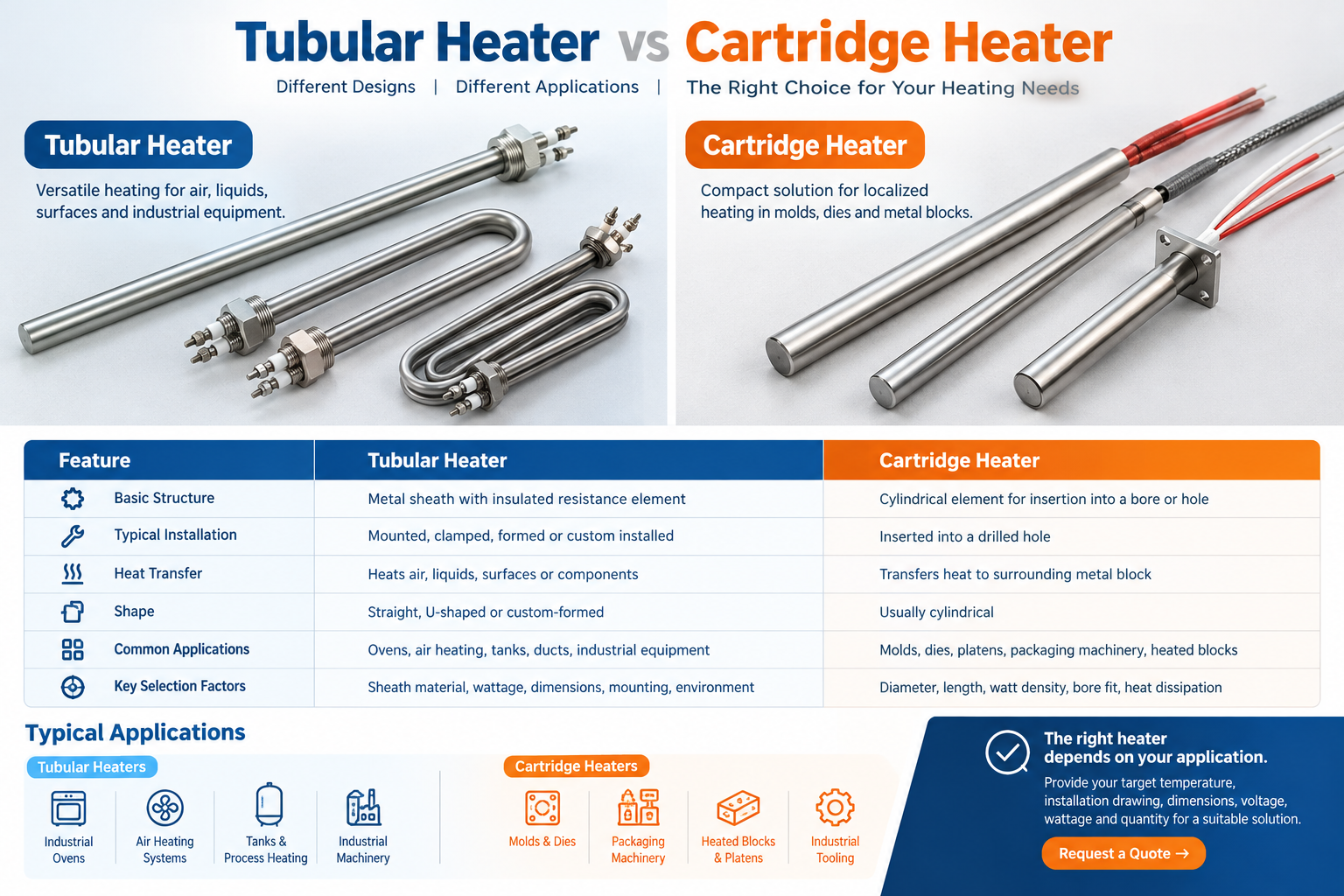
Heater Comparison: Tubular Heater vs Cartridge Heater
This Heater Comparison explains the key differences between tubular heaters and cartridge heaters, including their structures, installation methods, heat transfer methods, and industrial applications. Both are widely used industrial heating elements, but each is designed for different heating requirements.
In this Heater Comparison, we look at how tubular heaters and cartridge heaters work, where they are commonly used, and which type may be more suitable for different industrial heating applications.
1. What Is a Tubular Heater?
A tubular heater is an electric heating element made with a metal sheath, an internal resistance wire, and compacted magnesium oxide (MgO) insulation. When electricity passes through the resistance wire, heat is generated and transferred through the metal sheath to the surrounding material.
Tubular heaters are available in straight, U-shaped, W-shaped, and custom-bent configurations. They can be designed for heating air, liquids, surfaces, and industrial equipment.
Common applications include:
- Industrial ovens and drying equipment
- Air heating and ventilation systems
- Water and liquid heating equipment
- Packaging and processing machinery
- Industrial heating systems
Learn more about our tubular heater solutions.
2. What Is a Cartridge Heater?
A cartridge heater is a cylindrical electric heating element designed primarily for insertion into drilled holes in metal components. Its compact structure allows heat to transfer directly to the surrounding metal through close contact.
Cartridge heaters typically consist of a metal sheath, resistance wire, MgO insulation, and electrical leads or terminals. They are commonly used where concentrated and localized heating is required.
Common applications include:
- Plastic injection molding machines
- Hot runner systems
- Packaging machinery
- Dies and molds
- Industrial heating blocks
Explore our cartridge heater products and cartridge heater applications.
3. Heater Comparison: Key Differences
The main difference between tubular heaters and cartridge heaters is their structure and installation method. Tubular heaters are often shaped to fit different heating environments, while cartridge heaters are designed for insertion into accurately machined holes.
| Comparison Item | Tubular Heater | Cartridge Heater |
|---|---|---|
| Structure | Metal-sheathed heating element with flexible configurations | Cylindrical heating element |
| Installation | Mounted, immersed, or installed in heating equipment | Inserted into a drilled hole |
| Heating Method | Transfers heat through its sheath to air, liquids, or surfaces | Transfers heat through close contact with surrounding metal |
| Typical Applications | Ovens, tanks, air heaters, and industrial equipment | Molds, dies, hot runner systems, and heating blocks |
| Shape | Straight, U-shaped, W-shaped, and custom-bent | Usually straight and cylindrical |
| Design Considerations | Sheath material, wattage, shape, and mounting method | Diameter, length, wattage, fit, and operating temperature |
4. Heating Performance and Heat Transfer
Tubular Heater
Tubular heaters can transfer heat to air, liquids, and metal surfaces depending on their design and installation. Their performance depends on factors such as sheath material, wattage, surface loading, airflow or liquid circulation, and operating conditions.
Cartridge Heater
Cartridge heaters are commonly used for localized heating in metal components. Proper hole dimensions and close contact between the heater and the surrounding metal are important for effective heat transfer and service life.
For both heater types, selecting suitable wattage, voltage, dimensions, materials, and temperature controls is essential for reliable operation.
5. Advantages and Limitations
Tubular Heater Advantages
- Available in various shapes and configurations.
- Suitable for air, liquid, and surface heating applications.
- Can be customized for different equipment layouts.
Tubular Heater Considerations
- Installation space and mounting method must be considered.
- Sheath material must match the heating environment.
- Heating performance depends on the surrounding medium and operating conditions.
Cartridge Heater Advantages
- Compact design for localized heating.
- Suitable for molds, dies, and metal heating blocks.
- Available in different diameters, lengths, and wattage ratings.
Cartridge Heater Considerations
- Accurate machining of the installation hole is important.
- Clearance and contact conditions affect heat transfer.
- Incorrect wattage or poor installation may reduce service life.
6. Heater Comparison: How to Choose the Right Heater
Choosing between a tubular heater and a cartridge heater depends on the equipment structure, heating medium, installation space, and required temperature.
| Application Requirement | Recommended Heater Type | Reason |
|---|---|---|
| Heating air in an oven | Tubular Heater | Can be shaped and installed for air circulation heating. |
| Heating water or liquids | Tubular Heater | Can be designed for immersion or other liquid-heating arrangements. |
| Heating a metal mold | Cartridge Heater | Designed for insertion into drilled holes in metal components. |
| Heating a hot runner system | Cartridge Heater | Compact cylindrical design supports localized heating. |
| Custom-shaped industrial heating | Tubular Heater | Can be bent and configured to suit equipment requirements. |
Before selecting a heater, consider the following information:
- Required voltage and wattage
- Heater dimensions and available installation space
- Heating medium and operating environment
- Required operating temperature
- Sheath material and corrosion resistance requirements
- Temperature control and electrical connection requirements
7. Custom Industrial Heater Solutions from EaseWise
EaseWise supports industrial heating element sourcing and customization based on application requirements. We work with qualified manufacturing partners to help customers select suitable heater structures, materials, dimensions, and electrical specifications.
Whether you need tubular heaters for air or liquid heating, or cartridge heaters for molds and machinery, providing your technical requirements helps us evaluate a suitable solution.
For a quotation, please prepare the following information:
- Product drawing or dimensions
- Voltage and wattage
- Required quantity
- Application and operating environment
- Material or temperature requirements
8. Frequently Asked Questions
What is the main difference between a tubular heater and a cartridge heater?
A tubular heater can be formed into different shapes and used for air, liquid, and surface heating. A cartridge heater is cylindrical and is generally inserted into a drilled hole for localized heating.
Can a cartridge heater replace a tubular heater?
Not in every application. The correct choice depends on installation space, heating medium, heat transfer requirements, and equipment design.
Which heater is better for mold heating?
Cartridge heaters are commonly used for mold heating because they can be inserted into drilled holes in metal molds and heating blocks.
Which heater is suitable for liquid heating?
Tubular heating elements are commonly used in liquid-heating equipment. The heater design, sheath material, and installation method must be selected according to the liquid and operating conditions.
Conclusion
This Heater Comparison shows that the main difference between tubular heaters and cartridge heaters lies in their installation methods, heat transfer characteristics, and intended applications. Tubular heaters are versatile for air, liquid, and surface heating, while cartridge heaters are commonly used for localized heating in molds and metal components.
The right choice depends on your equipment design and operating requirements. Contact EaseWise to discuss your industrial heating project.
Contact EaseWise
Amy – Sales
Email: amy-EaseWise@tzheater.com
WhatsApp: +86 188 8318 8154
Hanna – Sales
Email: hanna-EaseWise@tzheater.com
WhatsApp: +86 173 5163 6811
Request a Quote and share your drawing, voltage, wattage, and quantity. Our team will review your requirements and respond within 12 hours.