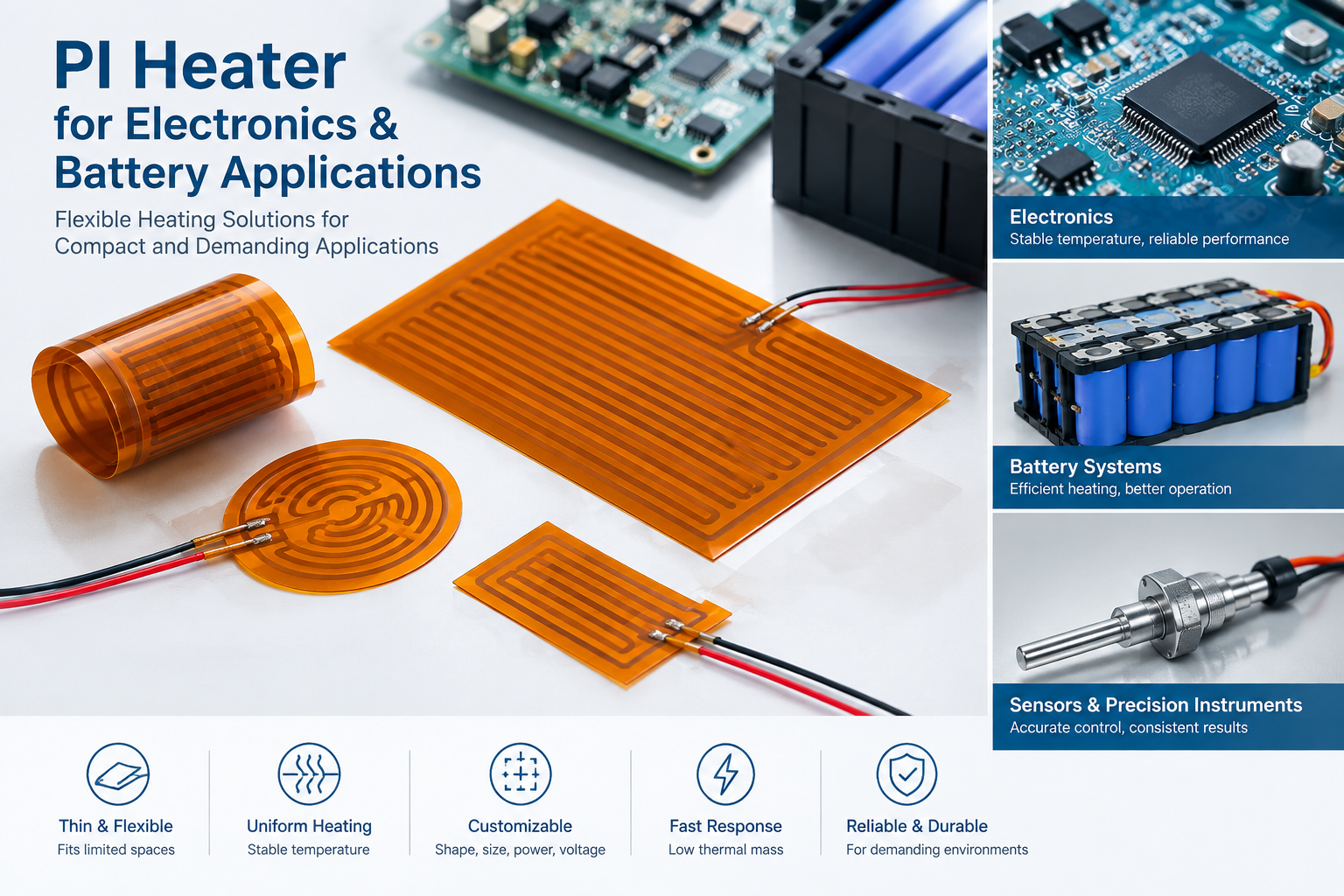
PI Heater for Electronics & Battery Applications
PI heater for electronics applications provides thin, flexible, and controlled heating for compact equipment, sensors, precision instruments, and other space-constrained systems. PI heaters are also widely suitable for battery systems where localized heating and flexible installation are required.
Because polyimide film is thin and flexible, PI heaters can be designed to match the available installation area while delivering controlled surface heat. This makes them suitable for electronics, battery systems, sensors, instruments, and other applications where conventional heaters may be too rigid or bulky.
Why Use a PI Heater for Electronics?
Electronic equipment often has limited installation space and requires controlled heating rather than high-temperature bulk heating. A PI heater can be manufactured in a thin, flexible format and positioned directly on or near the component that needs heat.
- Thin and flexible construction: The heater can conform to flat or slightly curved surfaces.
- Uniform surface heating: The heating element can be distributed across the required area.
- Compact installation: The thin construction is suitable for applications where installation space is limited.
- Customizable geometry: Heater dimensions, shape, power, voltage, and lead configuration can be specified according to the application.
- Fast thermal response: The low-mass construction can support relatively quick heating and temperature control.
PI Heater Applications in Electronics
Electronic equipment may require localized heating to maintain operating conditions, prevent condensation, or stabilize the temperature of sensitive components.
Electronic Components
PI heaters can be used for localized temperature control around electronic components where a compact heating solution is required.
The heater can be designed around the available installation area, helping engineers integrate heating without adding a large conventional heating assembly.
Sensors and Precision Instruments
Some sensors and precision instruments operate more consistently when their temperature is controlled. A thin PI heater can be installed close to the sensing or measurement area to provide localized heat.
For these applications, heater power and dimensions should be selected according to the required temperature range, surface area, thermal losses, and available power supply.
Display and Electronic Enclosures
In certain electronic enclosures and display-related equipment, controlled heating can help maintain the required operating environment. A flexible heater can be integrated into limited spaces without significantly increasing the overall assembly size.
PI Heater Applications in Battery Systems
Battery systems may require controlled heating when operating in low-temperature environments or when a specific temperature range is needed for system operation.
Battery Pack Heating
A PI heater can be placed on or near a battery pack to provide localized heat. The flexible construction allows the heater to follow the available mounting area and can simplify integration into compact battery assemblies.
Battery heating requirements vary according to battery chemistry, pack design, operating temperature, available power, and thermal management strategy. Heater specifications should therefore be selected based on the complete battery system rather than temperature requirements alone.
Battery Modules and Cells
For battery modules with limited installation space, a thin PI heater can provide a practical method of localized heating. The heater geometry can be adapted to the available surface area and installation requirements.
When designing a battery heating solution, engineers should consider heater placement, thermal contact, insulation, temperature sensing, and control strategy together.
Low-Temperature Battery Applications
Battery systems operating in cold environments may require additional thermal management. A PI heater can provide controlled auxiliary heat when integrated with an appropriate temperature monitoring and control system.
The required heater power depends on factors such as ambient temperature, battery size, insulation, target temperature, heat loss, and heating time.
PI Heater Construction
A typical PI heater uses an etched-foil heating element laminated between layers of polyimide film. This construction produces a thin and flexible heating element that can be customized for different shapes and installation requirements.
The heating circuit can be designed according to the required voltage, wattage, resistance, dimensions, and electrical connection configuration.
For applications requiring precise temperature control, a temperature sensor can also be incorporated into the overall heating system or positioned close to the heated surface.
PI Heater Design Considerations
Choosing a PI heater for electronics or battery applications requires more than selecting a heater by size. The electrical, thermal, mechanical, and installation requirements should be considered together.
| Parameter | What to Consider |
|---|---|
| Voltage | Match the heater to the available power supply. |
| Wattage | Determine the required heating power based on heat loss, target temperature, and heating time. |
| Dimensions | Define the available installation area and required heated surface. |
| Shape | Consider the component geometry and available mounting space. |
| Operating Temperature | Define the required working temperature and temperature limits. |
| Temperature Control | Consider whether a thermistor, thermocouple, or other sensor is required. |
| Lead Configuration | Specify lead position, length, insulation, and connector requirements. |
| Mounting | Consider adhesive backing, mechanical fixing, insulation, and thermal contact. |
PI Heater vs. Conventional Heating Methods
The main advantage of a PI heater in electronics and battery applications is its combination of thin construction, flexibility, and customizable heating area.
| Feature | PI Heater | Conventional Heater |
|---|---|---|
| Construction | Thin flexible film | Often more rigid or bulky |
| Installation | Suitable for compact spaces | May require additional installation space |
| Heating Area | Can be customized to the required geometry | Often based on standard heater dimensions |
| Flexibility | Suitable for flat and selected curved surfaces | Depends on heater construction |
| Application | Electronics, batteries, sensors, and instruments | Depends on heater type |
How to Specify a PI Heater
For a custom PI heater, providing the application and basic electrical requirements helps determine the appropriate heater construction.
- Define the application and component to be heated.
- Provide the available heater dimensions and shape.
- Specify the operating voltage.
- Define the required wattage or heating performance.
- Provide the target operating temperature.
- Specify the required lead position and lead length.
- Describe the mounting method and available installation space.
- Identify any temperature sensor or control requirements.
For battery and electronics applications, it is also useful to provide information about ambient temperature, insulation, heating time, and the surface or component being heated.
Why Choose a Custom PI Heater?
Standard heater sizes may not fit compact electronic assemblies or battery modules. A custom PI heater can be designed around the available space and required heating area.
EaseWise provides customized PI heater solutions based on application requirements, including heater dimensions, shape, voltage, wattage, lead configuration, and other specifications.
For more information about the product construction and available specifications, see the Standard Etched Foil PI Heater.
Get a Custom PI Heater for Your Application
If you are developing an electronics or battery heating application, send us your required heater dimensions, voltage, wattage, quantity, and available drawing or specification.
EaseWise can review the application requirements and provide a customized PI heater solution.
Request a quote: Get a Quote
You can also send a DXF or PDF drawing if you already have a heater outline or installation design.