
DS18B20 vs PT100: Which Temperature Sensor Should You Choose?
DS18B20 vs PT100 is a common comparison when selecting a temperature sensor for industrial equipment, monitoring systems, control cabinets, and temperature measurement applications. Both sensors can provide reliable temperature measurements, but they use different sensing technologies and are suited to different system requirements.
DS18B20 is a digital temperature sensor with a built-in signal conversion function, while PT100 is a platinum resistance temperature detector (RTD) that requires an appropriate measurement circuit or transmitter. The right choice depends on accuracy, wiring, temperature range, installation, and system design.
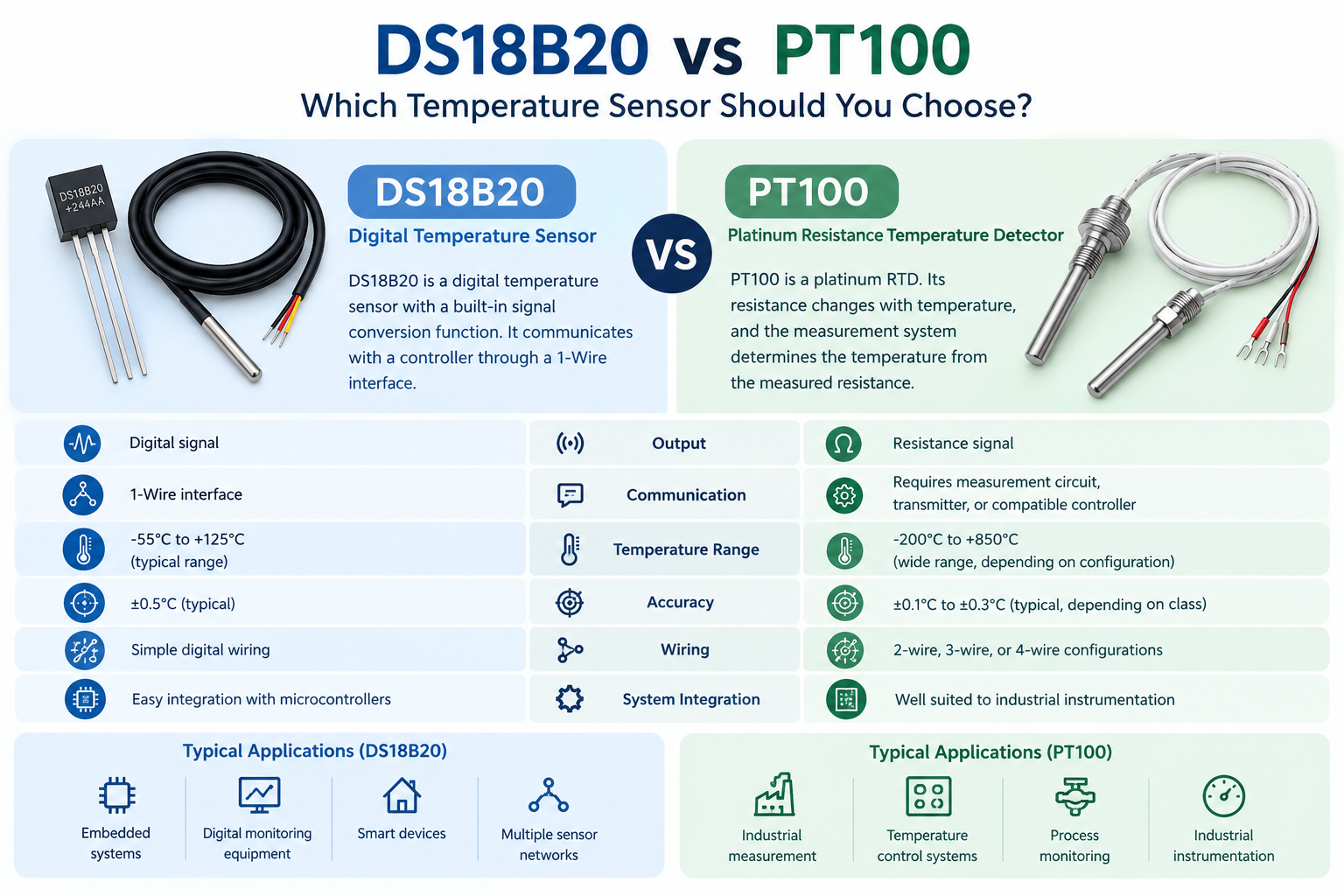
DS18B20 vs PT100: Key Differences
| Feature | DS18B20 | PT100 |
|---|---|---|
| Sensor Type | Digital temperature sensor | Platinum RTD |
| Output | Digital signal | Resistance signal |
| Communication | 1-Wire interface | Requires a measurement circuit, transmitter, or compatible controller |
| Typical Use | Digital monitoring and embedded temperature measurement | Industrial temperature measurement and control |
| Wiring | Digital 1-Wire connection | 2-wire, 3-wire, or 4-wire configurations |
| System Integration | Convenient for digital systems | Well suited to industrial instrumentation |
What Is a DS18B20 Temperature Sensor?
DS18B20 is a digital temperature sensor designed for direct digital temperature measurement. It communicates with a controller through a 1-Wire interface, allowing multiple sensors to be connected within a suitable system architecture.
Because the sensor provides a digital output, it can be convenient for embedded systems, monitoring equipment, data acquisition, and applications where direct integration with a microcontroller or digital control system is required.
For applications that require compact digital temperature monitoring, see our DS18B20 Temperature Sensor product page.
For additional technical specifications, see the official DS18B20 documentation from Analog Devices.
What Is a PT100 Temperature Sensor?
PT100 is a platinum resistance temperature detector (RTD). Its resistance changes with temperature, and the measurement system determines the temperature from the measured resistance.
PT100 sensors are widely used in industrial temperature measurement and control because they can be integrated into different instrumentation systems and wiring configurations. Depending on the application, PT100 sensors can use 2-wire, 3-wire, or 4-wire connections.
This makes PT100 a common choice when the temperature measurement system requires an RTD-based sensing element and compatibility with industrial temperature controllers, transmitters, or measurement instruments.
DS18B20 vs PT100: Accuracy and Measurement
The two sensors approach temperature measurement differently. DS18B20 performs temperature conversion internally and communicates the result digitally. PT100 produces a resistance value that must be measured by the connected instrumentation.
For DS18B20, overall measurement performance depends on the sensor, electrical installation, communication system, and application environment.
For PT100, measurement performance also depends on the RTD element, wiring configuration, measurement circuit, lead resistance, and the connected instrumentation.
Therefore, sensor selection should consider the complete measurement system rather than comparing the sensing elements alone.
DS18B20 vs PT100: Wiring and System Integration
DS18B20 Wiring
DS18B20 uses a digital 1-Wire communication interface. This can simplify integration with microcontrollers and other digital control systems, particularly when several sensors need to be monitored by the same controller.
Its digital communication architecture can be useful when temperature data needs to be processed directly by embedded software or a digital monitoring platform.
PT100 Wiring
PT100 can be connected using 2-wire, 3-wire, or 4-wire configurations. The choice depends on the required measurement accuracy and the instrumentation design.
In particular, 3-wire and 4-wire configurations can help reduce the influence of lead resistance in measurement systems where wiring resistance needs to be considered.
DS18B20 vs PT100: Which Applications Are Suitable?
| Application Requirement | Potentially Suitable Sensor | Why |
|---|---|---|
| Microcontroller-based temperature monitoring | DS18B20 | Digital communication can simplify system integration |
| Multiple digital temperature sensors | DS18B20 | 1-Wire architecture supports digital sensor networking |
| Industrial temperature measurement | PT100 | Common RTD solution for industrial instrumentation |
| Temperature control systems | PT100 | Compatible with many industrial controllers and measurement systems |
| Embedded monitoring equipment | DS18B20 | Direct digital output is convenient for digital systems |
| Applications requiring different RTD wiring configurations | PT100 | Available in 2-wire, 3-wire, and 4-wire measurement arrangements |
When Should You Choose DS18B20?
DS18B20 can be considered when the temperature measurement system is primarily digital and needs straightforward integration with a microcontroller or digital monitoring platform.
Typical considerations include:
- Digital temperature monitoring
- Embedded control systems
- Microcontroller-based equipment
- Compact monitoring devices
- Applications using a 1-Wire communication architecture
If the main requirement is convenient digital temperature data rather than integration with an RTD measurement loop, DS18B20 may fit the system architecture more naturally.
When Should You Choose PT100?
PT100 can be considered when the application uses industrial RTD instrumentation or requires compatibility with existing temperature controllers, transmitters, and measurement systems.
Typical considerations include:
- Industrial temperature measurement
- Process temperature monitoring
- Industrial control systems
- Temperature controllers and transmitters
- Systems requiring 2-wire, 3-wire, or 4-wire RTD configurations
PT100 is particularly relevant when the complete measurement system is designed around resistance-based temperature sensing.
DS18B20 vs PT100: How to Choose
The choice between DS18B20 and PT100 should be based on the requirements of the complete temperature measurement system.
| Selection Question | Consider DS18B20 When… | Consider PT100 When… |
|---|---|---|
| How will the signal be processed? | The system is designed for digital data | The system uses RTD resistance measurement |
| What controller is being used? | A microcontroller or digital controller | An industrial temperature controller or transmitter |
| What wiring is required? | 1-Wire digital communication | 2-wire, 3-wire, or 4-wire RTD wiring |
| What is the application environment? | Digital monitoring or embedded equipment | Industrial measurement and control |
| What should be checked first? | Controller compatibility and communication architecture | RTD input compatibility, wiring, and measurement circuit |
DS18B20 vs PT100: Final Selection Checklist
Before selecting a temperature sensor, check the following requirements:
- Required temperature measurement range
- Required measurement accuracy
- Controller or instrument compatibility
- Digital or resistance-based signal requirements
- Wiring configuration
- Installation space and sensor dimensions
- Environmental conditions
- Required cable length and connector configuration
- Whether the sensor will be used for monitoring or industrial control
There is no single sensor configuration suitable for every application. The correct choice depends on the temperature range, measurement architecture, controller, installation conditions, and required performance.
Related Temperature Sensor Solutions
Explore our DS18B20 Temperature Sensor Applications page for application-related information.
If you need a custom temperature sensor configuration, please provide the required temperature range, sensor type, dimensions, cable length, connector, quantity, and application requirements.
Request a Quote for your temperature sensor requirements.