
Silicone Rubber Heater Troubleshooting
Silicone Rubber Heater Troubleshooting starts with checking the power supply, resistance, installation, temperature control, and operating environment. When a silicone rubber heater does not heat properly, heats unevenly, or shows temperature-control or insulation problems, the cause is not always the heater itself.
This Silicone Rubber Heater Troubleshooting guide covers five common problems, what to check first, and how to choose a suitable heating solution when the heater needs to be replaced or redesigned.
Silicone Rubber Heater Troubleshooting: Heater Not Heating
If the heater does not produce heat at all, start with the simplest checks before assuming that the heating element has failed.
- Check whether the power supply is working correctly.
- Check the rated voltage and actual supply voltage.
- Check whether the thermostat or temperature controller is set correctly.
- Measure the heater resistance with a multimeter.
- Check the wiring, terminals, and lead connections for damage.
Resistance measurement is one of the quickest ways to identify a potential electrical problem. If the measured resistance is significantly different from the expected value, the heating element or internal circuit may require further inspection.
| Check | What to Look For |
|---|---|
| Power supply | Correct voltage and stable power output |
| Resistance | Resistance should match the heater specification |
| Thermostat | Correct setting and normal switching operation |
| Wiring | No broken, loose, or damaged connections |
For comparison, review the specifications and available configurations of our silicone rubber heater product range.
Silicone Rubber Heater Troubleshooting: Uneven Heating
Uneven heating is often related to the heating layout rather than simply the heater material.
Common causes include:
- The heating area does not match the actual surface that needs heating.
- Heating zones are not distributed appropriately.
- Voltage is unstable.
- The heater is not installed evenly against the target surface.
- There is insufficient contact between the heater and the heated surface.
- The required temperature is different from the original design condition.
For custom silicone rubber heaters, EaseWise can review the application environment, target temperature, heating area, dimensions, and installation requirements before production.
For applications where heating uniformity is important, providing a drawing or layout showing the required heating area can help us design the heating pattern more accurately.
Temperature Control Problems with Silicone Rubber Heaters
If the heater continues heating after reaching the target temperature, the temperature-control system should be checked as part of the Silicone Rubber Heater Troubleshooting process.
Depending on the application, silicone rubber heaters can be supplied with different temperature-control options, including:
| Temperature Control | Typical Use |
|---|---|
| Knob Thermostat | Simple temperature adjustment for general heating applications |
| Digital Thermostat | More precise temperature monitoring and control |
| Thermocouple / Sensor | Applications requiring temperature feedback to an external controller |
For compact equipment, a built-in thermostat or sensor configuration can also be considered to reduce installation complexity. The appropriate solution depends on the target temperature, control accuracy, available space, and equipment design.
If you are unsure which temperature-control method is appropriate, provide your required temperature range and power supply when contacting EaseWise.
Insulation Resistance and Leakage Problems
If the heater shows a significant drop in insulation resistance or electrical leakage, stop operation and inspect the heater and installation environment before continuing to use it.
Silicone rubber is moisture-resistant and suitable for many demanding environments, but a silicone rubber heater should not automatically be assumed to be suitable for continuous immersion or every wet environment.
Possible factors include:
- Moisture entering damaged areas.
- Physical damage to the heater surface.
- Improper installation.
- Long-term exposure to unsuitable environmental conditions.
- Operating conditions that differ from the original application requirements.
Before selecting a heater, confirm the actual operating environment, temperature, mounting method, and exposure to moisture or chemicals.
For more information about common applications, see our Silicone Rubber Heater Applications guide.
Physical Damage to Silicone Rubber Heaters
Silicone rubber heaters are flexible, but they still need to be installed and handled correctly.
Common causes of physical damage include:
| Problem | Possible Cause | Prevention |
|---|---|---|
| Torn or stretched area | Excessive pulling during installation | Install without excessive mechanical tension |
| Puncture or surface damage | Sharp edges, tools, or mounting hardware | Keep the mounting surface clean and free of sharp edges |
| Cracking or aging | Long-term exposure to unsuitable temperature or environment | Select materials and construction for actual operating conditions |
| Poor contact | Incorrect installation or unsuitable surface shape | Confirm heater dimensions and surface configuration before production |
The flexibility of silicone allows the heater to conform to many curved surfaces, but the heater should still be designed around the actual installation geometry rather than being forced into an unsuitable shape.
How EaseWise Helps Prevent Silicone Rubber Heater Problems
Many heater problems can be reduced by confirming the application before production.
For a custom silicone rubber heater, EaseWise can consider:
- Heater size and heating area
- Rated voltage and power
- Target operating temperature
- Required watt density
- Surface shape and installation method
- Thermostat or thermocouple requirements
- Operating environment
- Lead wire and connection configuration
Instead of selecting a heater based only on size and wattage, providing the actual equipment conditions helps determine whether the heating layout, temperature control, and construction are suitable for the application.
Choose the Right Silicone Heating Solution
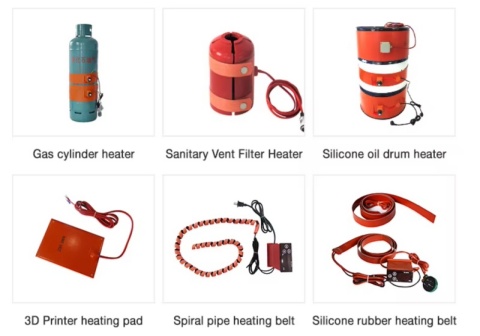
Not every heating problem requires the same heater design. If the application involves a specific tank, cylinder, drum, or curved surface, a dedicated heating solution may be more practical than a general-purpose heating pad.
Silicone Rubber Heater
A standard or custom silicone rubber heater is suitable for many applications requiring flexible surface heating. Size, voltage, power, shape, sensor configuration, and temperature-control options can be customized according to the equipment.
Silicone Rubber Heater Watt Density Guide
Selecting the correct heating power is important for reliable performance. Learn more about power selection and heating performance in our Silicone Rubber Heater Watt Density Guide .
LPG Cylinder Heater
For LPG, propane, and gas cylinder applications, a dedicated LPG Cylinder Heater provides a heating-jacket configuration designed specifically for gas cylinders and tanks.
This type of heater can be considered when the goal is to maintain cylinder temperature, improve gas vaporization, or provide controlled heating around the cylinder surface.
Oil Drum Heater
For drums and barrels, an Oil Drum Heater provides a dedicated solution for heating materials inside industrial drums and barrels.
The appropriate solution depends on the container size, target temperature, material being heated, heating time, and required temperature-control method.
Need Help with Silicone Rubber Heater Troubleshooting?
If your heater is not heating, heats unevenly, has temperature-control problems, shows insulation resistance issues, or has physical damage, send us the heater specifications and application details.
Useful information includes:
- Heater dimensions
- Voltage and wattage
- Measured resistance
- Target temperature
- Heated surface or equipment type
- Installation method
- Photos or drawings, if available
EaseWise can review the application and recommend a suitable silicone heating solution or custom configuration.
Contact EaseWise for Technical Support
Amy
WhatsApp:
+86 188 8318 8154
Email:
amy-easewise@tzheater.com
Hanna
WhatsApp:
+86 173 5163 6811
Email:
hanna-easewise@tzheater.com
Tell us your voltage, wattage, dimensions, target temperature, and application. We can help you determine the right heating configuration.