
Thermocouple Extension Cable vs Compensating Cable
When connecting a thermocouple to a temperature controller, transmitter, or measurement instrument, the cable type can affect measurement accuracy. Understanding the difference between a thermocouple extension cable vs compensating cable helps you choose the correct wiring for your temperature measurement system.
Both cable types are designed to transmit thermocouple signals. However, they differ in conductor materials, thermoelectric characteristics, operating temperature limits, and typical applications.
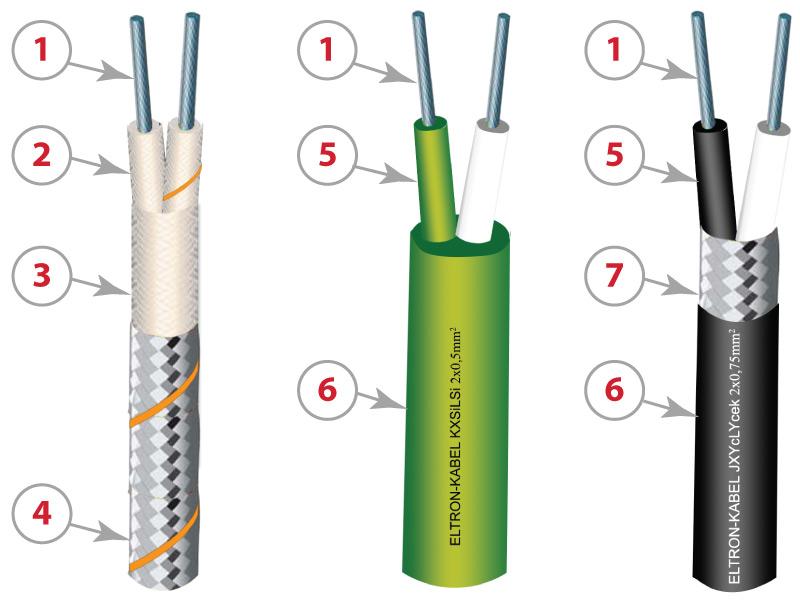
What Is a Thermocouple Extension Cable?
A thermocouple extension cable is used to extend the electrical signal from a thermocouple to a measuring instrument. Its conductors have the same nominal composition as the corresponding thermocouple alloys.
For example, a Type K extension cable uses conductor materials corresponding to the Type K thermocouple. This allows the cable to continue the thermoelectric circuit while maintaining the expected signal characteristics within its specified limits.
Extension cables are commonly identified by adding the letter X after the thermocouple type:
- Type K: KX
- Type J: JX
- Type T: TX
- Type E: EX
- Type N: NX
Extension cable selection must also consider insulation material, conductor size, cable temperature, and the required accuracy class.
What Is a Thermocouple Compensating Cable?
A thermocouple compensating cable also connects a thermocouple to a measuring instrument. However, its conductors are made from different alloy compositions than the original thermocouple.
These alternative materials are designed to reproduce similar thermoelectric characteristics over a specified temperature range. This makes compensating cables a practical option for certain installations, particularly when longer cable runs or more economical wiring are required.
Compensating cables are commonly identified by the letter C after the thermocouple type. Additional letters may identify different conductor combinations or tolerance characteristics.
Examples include:
- Type K: KCA or KCB
- Type N: NC
- Type R: RCA or RCB
- Type S: SCA or SCB
Not every thermocouple type has the same compensating cable options. Always confirm the correct cable designation and temperature range with the applicable standard or manufacturer’s datasheet.
Key Differences Between Extension and Compensating Cables
The main difference between extension cable and compensating cable is the conductor material used to reproduce the thermocouple’s thermoelectric output.
| Comparison | Extension Cable | Compensating Cable |
|---|---|---|
| Conductor material | Same nominal alloy composition as the corresponding thermocouple | Different alloy composition designed to match thermoelectric behavior |
| Thermoelectric characteristics | Designed to continue the corresponding thermocouple circuit | Designed to reproduce a similar output within a specified range |
| Identification | Usually marked with X, such as KX or JX | Usually marked with C, such as KCA or KCB |
| Temperature limits | Limited by conductor specifications and insulation rating | Limited by the specified compensation range and insulation rating |
| Accuracy | Depends on cable tolerance class and installation conditions | Depends on compensation characteristics, tolerance class, and installation conditions |
| Cost | Can be more expensive depending on thermocouple alloy | Can offer a more economical option for suitable applications |
| Typical use | General signal extension and installations requiring matching conductor alloys | Signal extension where the cable temperature remains within its specified compensation range |
Neither cable type is automatically more accurate in every installation. The correct choice depends on the thermocouple type, cable grade, temperature conditions, and measurement requirements.
Thermocouple Cable Temperature Range and Limits
Temperature limits are an important consideration when selecting thermocouple cables. However, two different temperature ratings must be considered:
- Conductor or compensation temperature range: The temperature range in which the cable maintains its specified thermoelectric characteristics.
- Insulation temperature rating: The maximum temperature that the cable insulation and outer sheath can withstand under specified conditions.
For extension cables, the applicable temperature range depends on the conductor grade and insulation material. For compensating cables, the temperature at the connection between the thermocouple and cable must also remain within the specified compensation range.
For example, a cable with PTFE insulation and one with PVC insulation may have different allowable operating temperatures even when used with the same thermocouple type.
Do not select a cable based only on the maximum temperature of the thermocouple sensor. Check the cable’s conductor specifications, insulation rating, and connection temperature requirements separately.
How to Choose the Right Thermocouple Extension or Compensating Cable
The right cable depends on the installation environment and required measurement performance. Consider the following factors before making a selection.
1. Thermocouple Type
First, identify the thermocouple type, such as K, J, T, E, N, R, or S. The extension or compensating cable must be compatible with the sensor type.
Using a cable intended for a different thermocouple type can introduce additional thermoelectric voltage and measurement errors.
2. Cable Installation Temperature
Check the temperature around the entire cable route, especially at the connection between the thermocouple and extension or compensating cable.
If a compensating cable is used, its connection temperature must remain within the specified compensation range. If the installation exceeds that limit, select a suitable alternative cable grade.
3. Measurement Accuracy
For applications requiring reliable temperature readings, check the cable tolerance class and the expected measurement uncertainty.
Both extension and compensating cables introduce additional tolerances into the measurement circuit. Proper material matching, polarity, installation, and connection practices are important.
4. Cable Length and Conductor Size
Long cable runs require consideration of conductor resistance, signal transmission, electrical interference, and the input requirements of the measuring instrument.
Select an appropriate conductor cross-section and consider shielding where electrical noise may affect the measurement signal.
5. Insulation and Environmental Conditions
Choose the insulation and outer sheath according to the installation environment.
- PVC: Commonly used for general industrial environments.
- PTFE or FEP: Suitable for applications requiring specific chemical and temperature resistance.
- Fiberglass: Used in certain higher-temperature environments.
- Shielded construction: Helps reduce electrical interference in suitable installations.
Always confirm the actual temperature, chemical resistance, and mechanical ratings of the selected cable construction.
Common Thermocouple Cable Selection Mistakes
- Using ordinary copper cable: Standard copper wire is not a direct replacement for thermocouple extension or compensating cable. Additional junctions can introduce unwanted thermoelectric voltage.
- Mixing thermocouple types: A Type K cable should not be selected for a Type J thermocouple simply because the cable looks similar.
- Ignoring polarity: Reversed positive and negative conductors can cause incorrect temperature readings.
- Ignoring connection temperature: Compensating cable may produce additional errors when its connection temperature exceeds the specified range.
- Checking only the insulation rating: Insulation temperature resistance does not guarantee that the conductor pair maintains the required thermoelectric accuracy.
- Mixing extension and compensating grades without verification: Different cable grades should not be interchanged unless their compatibility is confirmed.
Custom Thermocouple Extension and Compensating Cable Solutions
EaseWise provides sourcing and customization support for industrial temperature measurement components and OEM requirements.
When selecting a thermocouple cable or matching temperature sensor, the following information helps us evaluate your requirements:
- Thermocouple type, such as K, J, T, E, N, R, or S
- Extension or compensating cable requirement
- Conductor size and cable length
- Insulation and outer sheath material
- Operating and connection temperature
- Shielding and installation requirements
- Required quantity
For related temperature measurement products and OEM requirements, contact our team through the EaseWise inquiry page.
Thermocouple Extension Cable vs Compensating Cable FAQs
Can I use a compensating cable instead of an extension cable?
In some applications, yes. A compatible compensating cable can be used when its thermoelectric characteristics and specified temperature range meet the installation requirements. Check the cable designation and manufacturer specifications before substitution.
Are thermocouple extension cables and compensating cables interchangeable?
No. They use different conductor materials and may have different temperature ranges and tolerances. They should only be substituted when compatibility is confirmed for the thermocouple type and installation conditions.
What does KX mean in thermocouple cable?
KX identifies a Type K thermocouple extension cable. The X indicates extension grade, which uses conductors with the same nominal alloy composition as the corresponding Type K thermocouple.
What do KCA and KCB mean?
KCA and KCB are Type K compensating cable designations. They use alternative conductor materials and have specified thermoelectric characteristics and temperature ranges. Their exact specifications should be checked against the relevant standard and supplier datasheet.
Can ordinary electrical wire be used for thermocouple extension?
Ordinary electrical wire is generally not suitable as a direct replacement. The conductor materials can create additional thermoelectric effects and cause measurement errors. Use a cable compatible with the thermocouple type.
Request a Thermocouple or Cable Solution
Need help selecting a thermocouple, extension cable, or compensating cable for your industrial application? Send us your technical requirements, including thermocouple type, cable length, insulation material, operating temperature, and quantity.
For a faster quotation, please provide a PDF or DXF drawing if available. Our team will review your requirements and respond within 12 hours.
Contact EaseWise:
- Amy Sales: amy-EaseWise@tzheater.com | WhatsApp: +86 188 8318 8154
- Hanna Sales: Hanna-EaseWise@tzheater.com | WhatsApp: +86 173 5163 6811