
Thermocouple Types: K, J, T, E, N, S, R & B Selection Guide
Thermocouple types are temperature sensors that differ in temperature range, sensitivity, stability, accuracy, and material cost. Choosing the right thermocouple type depends mainly on the operating temperature, environment, required measurement performance, and application requirements.
This guide compares the eight common thermocouple types — K, J, T, E, N, S, R, and B — to help engineers, purchasing teams, and distributors select a suitable temperature sensor for industrial applications.
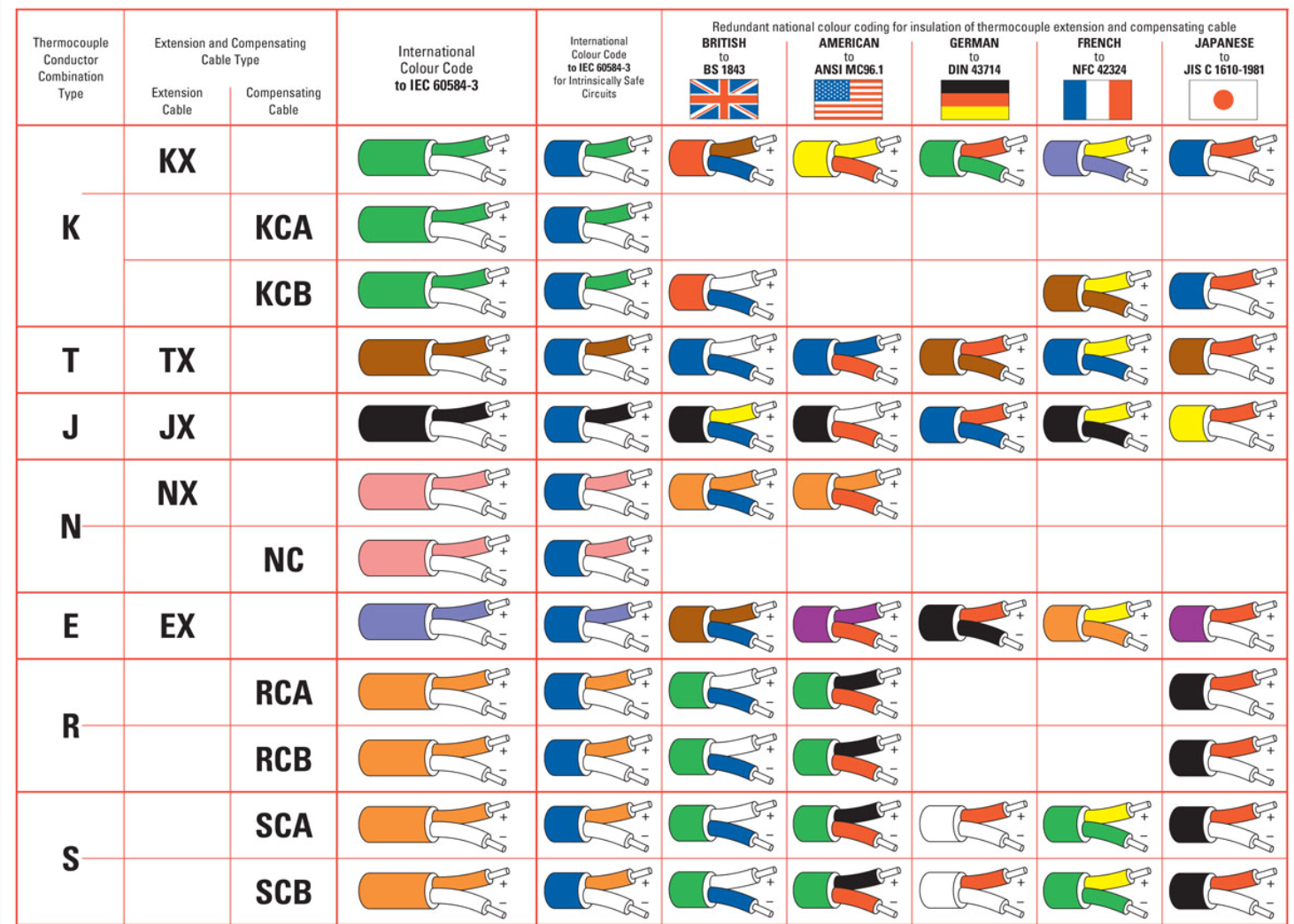
Thermocouple Types Comparison
The table below provides a practical comparison of K, J, T, E, N, S, R, and B type thermocouples. These thermocouple types cover a wide range of industrial temperature measurement requirements. Actual temperature limits depend on the thermocouple type, wire diameter, construction, sheath, insulation, atmosphere, and installation conditions.
| Type | Materials | Typical Engineering Use | Key Features & Applications |
|---|---|---|---|
| K | Nickel-Chromium / Nickel-Silicon | Broad industrial temperature range | General-purpose type widely used in industrial heating equipment, ovens, machinery, and process monitoring. |
| J | Iron / Copper-Nickel | Low-to-mid temperature industrial applications | Good sensitivity and commonly used for plastic processing, extrusion, packaging, drying, and other industrial equipment. |
| T | Copper / Copper-Nickel | Low-temperature measurement | Good low-temperature performance for refrigeration, laboratory, food-processing, and other low-temperature applications. |
| E | Nickel-Chromium / Copper-Nickel | Low-to-medium temperature measurement | High thermoelectric output and good sensitivity for suitable industrial and laboratory applications. |
| N | Nickel-Chromium-Silicon / Nickel-Silicon-Magnesium | High-temperature industrial measurement | Good stability and an alternative to K Type for some high-temperature oxidizing environments. |
| S | Platinum-10% Rhodium / Platinum | High-temperature measurement | Good high-temperature stability for furnaces, laboratories, calibration, and demanding measurement applications. |
| R | Platinum-13% Rhodium / Platinum | High-temperature measurement | High-temperature stability for industrial furnaces and demanding measurement applications. |
| B | Platinum-30% Rhodium / Platinum-6% Rhodium | Very high-temperature applications | Designed for very high-temperature measurement, including suitable furnace and heat-treatment applications. |
Note: The ranges and descriptions above are practical engineering guidance rather than universal operating limits. Reference-function ranges and actual usable temperatures vary by thermocouple type, construction, wire size, protection, atmosphere, and application. Always confirm the required service temperature for the specific sensor design.
How to Choose the Right Thermocouple Type
The thermocouple type should be selected according to the actual application rather than temperature range alone. Consider the following factors before specifying a sensor.
1. Start With the Operating Temperature
Choose a thermocouple type that comfortably covers the normal operating temperature and expected temperature fluctuations. Avoid selecting a sensor only because its published maximum temperature appears suitable.
2. Consider the Operating Environment
Oxidizing, reducing, corrosive, vacuum, high-vibration, and contaminated environments can affect thermocouple performance and service life. The sheath material, insulation, protection method, and installation configuration should match the environment.
The correct thermocouple type should also be matched to the process environment, installation conditions, and required service life rather than temperature range alone.
3. Check Accuracy and Stability Requirements
K, J, T, E, and N types are widely used for general industrial temperature measurement. S, R, and B types are generally selected for demanding high-temperature applications where long-term stability and measurement performance are important.
4. Consider Total Cost
Base-metal thermocouples such as K, J, T, E, and N are generally more economical for industrial applications. Platinum-rhodium types such as S, R, and B offer high-temperature performance but have significantly higher material costs.
For different industrial environments and installation requirements, see our Thermocouple Applications and Temperature Measurement Solutions.
N Type Thermocouple vs K Type Thermocouple
N type and K type thermocouples both cover broad temperature ranges and are widely considered for industrial temperature measurement. N Type can provide good stability in some high-temperature oxidizing environments, while K Type remains a common general-purpose choice.
The appropriate choice depends on the actual temperature, atmosphere, required accuracy, installation conditions, and expected service life. No single thermocouple type is suitable for every application.
Thermocouple Types for High-Temperature Applications
S Type, R Type, and B Type thermocouples use platinum-rhodium materials and are designed for high-temperature measurement applications.
S and R types are commonly considered where high-temperature stability and measurement performance are important. B Type is particularly suitable for very high-temperature furnace and heat-treatment applications when the overall sensor construction is appropriate.
For high-temperature applications, the thermocouple element is only one part of the measurement system. Sheath material, protection method, insulation, installation depth, and operating atmosphere can significantly affect service life and measurement performance.
For applications requiring a platinum-rhodium sensor, see our Platinum-Rhodium Assembly Thermocouple.
Thermocouple Construction and Installation
Selecting the thermocouple type is only the first step. The sensor construction should also match the installation requirements.
A Sheathed Thermocouple provides a compact sensing configuration with the thermocouple element protected inside a metal sheath. It can be useful where probe diameter, installation space, and response time are important. For help choosing the right sheath material, see our Thermocouple Sheath Material: SS304 vs SS316 vs Inconel guide.
For fixed industrial installations, assembly configurations can provide additional mounting and protection options. Our Sheathed vs Assembly Thermocouple comparison explains the practical differences between these two configurations.
For applications where probe diameter and insertion length are important, see our Thermocouple Probe Diameter and Insertion Length Selection Guide.
Thermocouple Wiring and Installation Tips
- Use the correct thermocouple extension or compensating cable for the selected thermocouple type.
- Keep polarity and wiring consistent during installation.
- Choose suitable sheath and insulation materials for the operating environment.
- Consider daily operating time, temperature fluctuations, and thermal cycling rather than only the maximum temperature.
- Position the sensing junction correctly to obtain representative temperature measurements.
- For unusual or demanding applications, confirm the expected measurement error and practical service temperature before production.
For thermocouple wiring requirements, see our Thermocouple Wire & Extension Cable product range.
Related Thermocouple Products
EaseWise provides different thermocouple configurations for industrial temperature measurement. The appropriate product depends on the thermocouple type, installation method, probe dimensions, protection requirements, and operating environment.
- Industrial Thermocouples – general industrial temperature sensors available in different thermocouple types and configurations.
- Sheathed Thermocouple – compact configuration for industrial equipment and applications with limited installation space.
- Platinum-Rhodium Assembly Thermocouple – suitable for demanding high-temperature measurement applications.
- Thermocouple Wire & Extension Cable – for connecting thermocouple sensors to temperature controllers and measurement systems.
Thermocouple Selection for Engineers, Purchasing Teams and Distributors
For engineers: Actual application conditions should determine the thermocouple type and construction. EaseWise can help evaluate practical operating temperature, installation conditions, sensor configuration, and demanding operating environments.
For purchasing teams: Both base-metal and precious-metal thermocouples can be supplied according to project specifications and quantity requirements.
For distributors and traders: Common base-metal thermocouples can be supplied with inventory support and delivery options. OEM packaging and customized specifications are also available.
Need Help Choosing a Thermocouple?
Tell us your temperature range, thermocouple type, application, installation method, sheath material, sensor length, and quantity. EaseWise can recommend a suitable thermocouple type and configuration for your application.
Contact EaseWise for Thermocouple Solutions
Amy – Sales
Email:
Amy-Easewise@tzheater.com
WhatsApp:
+86 188 8318 8154
Hanna – Sales
Email:
Hanna-Easewise@tzheater.com
WhatsApp:
+86 173 5163 6811