
How to Choose a PI Heater: Voltage, Wattage, Size and Temperature
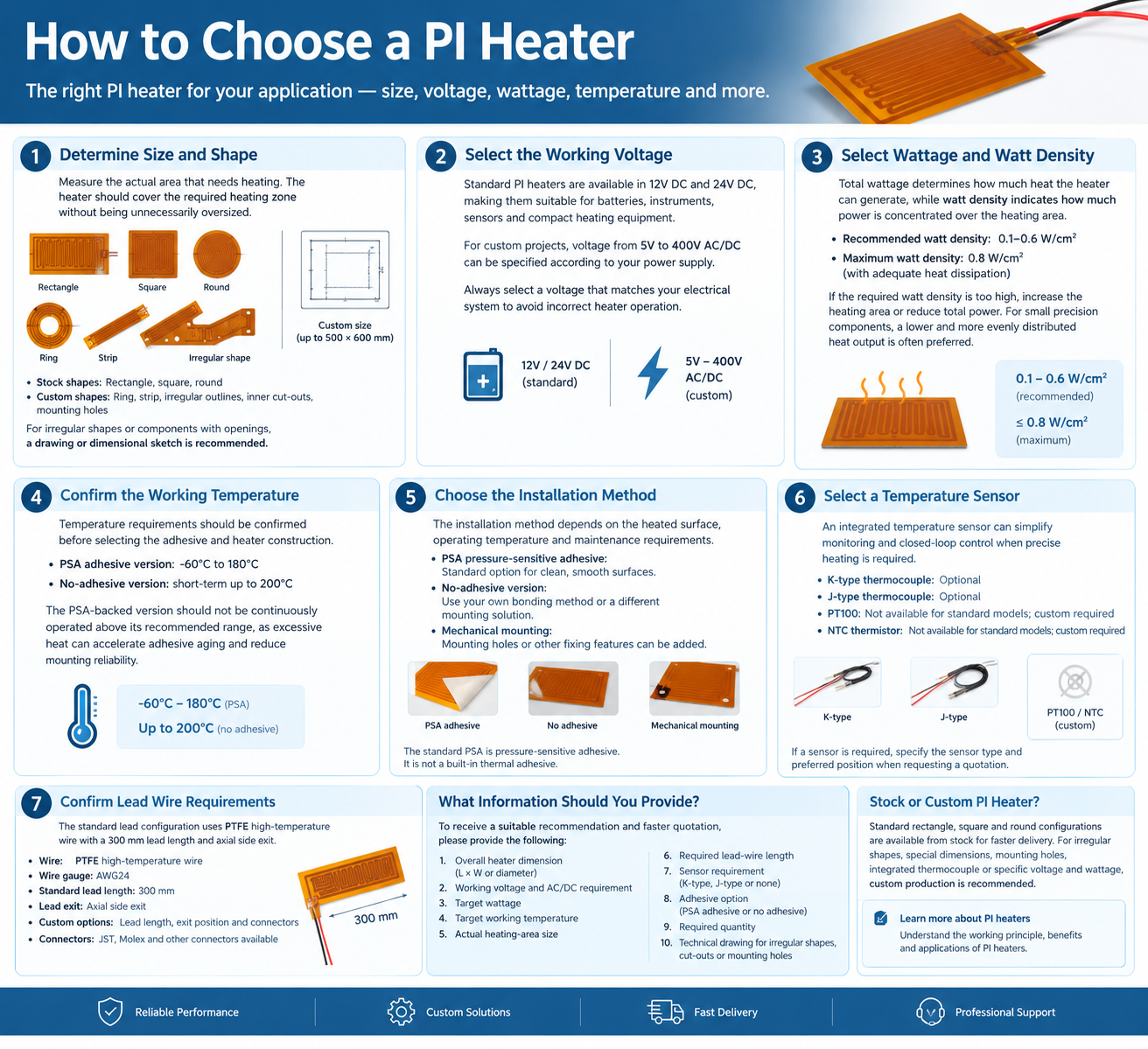
How to choose a PI heater depends mainly on the required heating area, voltage, wattage, working temperature, and installation method. Confirming these parameters before ordering helps prevent insufficient heating, overheating, and installation problems. This guide explains the main factors to consider when selecting a standard or custom polyimide heater.
How to Choose a PI Heater for Your Application
Selecting the right PI heater starts with the actual heating requirements and installation conditions. Consider the heater size and shape, electrical requirements, operating temperature, mounting method, temperature sensing, and lead wire configuration before placing an order.
1. Determine PI Heater Size and Shape
The heating area should match the surface or component that needs to be heated. PI heaters can be designed in different shapes to fit flat or irregular installation areas.
For custom heaters, provide the required length, width, shape, hole locations, cut-outs, and heating area whenever possible. Custom dimensions can be considered based on the available installation space and electrical requirements.
2. Select Working Voltage
Choose the heater voltage according to the available power supply and the requirements of the equipment. EaseWise PI heaters can be configured for different voltage requirements, with the product range covering approximately 3V to 380V depending on the heater design.
When requesting a quotation, specify the required voltage and whether the application uses AC or DC power. This helps ensure that the heater resistance and electrical configuration are suitable for the application.
3. Select Wattage and Watt Density
The required wattage depends on the heating area, target temperature, heat loss, material being heated, and required heat-up time. Watt density is also important because excessive power concentration can cause overheating, while insufficient watt density may result in slow heating.
As a general reference, PI heater watt density may be approximately 0.1–1.0 W/cm² depending on the application, with around 0.3–0.5 W/cm² commonly used in many applications. The appropriate value should be determined according to the actual thermal conditions.
For custom PI heaters, provide the target wattage or heating temperature whenever possible so the heater design can be matched to the application.
4. Confirm Working Temperature
Confirm both the required operating temperature and the maximum temperature the heater may experience. PI heaters can be used across a wide temperature range, with typical configurations operating from approximately -60°C to 200°C depending on the heater construction and application.
If the heater uses pressure-sensitive adhesive, the continuous operating temperature also depends on the adhesive selected. For higher-temperature applications, a different installation method may be required.
5. Choose the Installation Method
PI heaters can be supplied with different mounting options depending on the application. Adhesive backing is convenient for bonding the heater directly to a suitable surface, while mechanical mounting or other installation methods may be preferable when the heater needs to be removable or exposed to higher temperatures.
For adhesive-mounted heaters, confirm that the bonding surface is clean, smooth, and compatible with the selected adhesive. For custom designs, mounting holes, cut-outs, and other installation features can be incorporated into the heater layout.
6. Select the Temperature Sensor
Temperature sensing can help control heater output and maintain the required operating temperature. Depending on the configuration, PI heaters can be designed with integrated NTC, PT100, PT1000, K-type, or J-type temperature sensors.
When selecting a sensor, consider the required temperature range, controller compatibility, sensor position, and control accuracy. For custom heaters, specify the preferred sensor type and location before production.
7. Confirm Lead Wire Requirements
Lead wire selection depends on the operating temperature, electrical requirements, installation environment, and connection method. PTFE, silicone, and other custom lead wire configurations may be available depending on the heater design.
When ordering a custom PI heater, provide the required lead wire length, exit position, connector type, and other connection requirements. A standard lead length may be available for some configurations, while custom lengths can be specified for individual applications.
What Information Should You Provide When Ordering a PI Heater?
Providing complete application information helps reduce design changes and quotation time. For a standard or custom PI heater, we recommend providing:
- Heater length and width or required heating area
- Heater shape, holes, cut-outs, or other dimensional requirements
- Working voltage
- Required wattage or target temperature
- Operating temperature
- Installation or mounting method
- Temperature sensor type and position, if required
- Lead wire length, exit position, and connector requirements
- Quantity required
- Application or equipment information
Stock or Custom PI Heater?
Standard PI heaters can be suitable when the required size, voltage, wattage, and configuration match an existing design. Custom polyimide heaters are more suitable when the application requires a specific shape, mounting pattern, sensor position, lead configuration, or electrical specification.
EaseWise provides both standard and custom PI heater solutions for industrial and precision heating applications.
Related PI Heater Resources
- PI Heater – Polyimide Film Heating Solutions
- What Is a PI Heater? Working Principle, Benefits and Applications
- Standard Etched-Foil PI Heater
- PI Heater vs Silicone Rubber Heater
Need a Custom PI Heater?
If you already know the required size, voltage, wattage, temperature, and installation method, you can send these specifications to EaseWise for evaluation. For custom designs, you can also provide a drawing or DXF/PDF file showing the required dimensions and installation details.
Request a PI Heater Quote and provide your voltage, wattage, dimensions, quantity, and application requirements. Our team can review the specifications and recommend a suitable configuration.
Amy – Sales
Email: amy-easewise@tzheater.com
WhatsApp: +86 188 8318 8154
Hanna – Sales
Email: hanna-easewise@tzheater.com
WhatsApp: +86 173 5163 6811