
PI Heater vs Silicone Rubber Heater: Which Flexible Heater Is Better?
PI Heater vs Silicone Rubber Heater is an important comparison when selecting a flexible heating solution for industrial equipment, precision instruments, batteries, electronics, and temperature-control applications. A PI heater provides an ultra-thin structure, fast thermal response, and lightweight design, while a silicone rubber heater offers a more robust construction for larger heating areas and higher power requirements. The right choice depends on installation space, heating area, temperature requirements, and operating conditions.
Before comparing the two technologies, see our guide What Is a PI Heater? for PI heater construction, working principles, and typical applications.
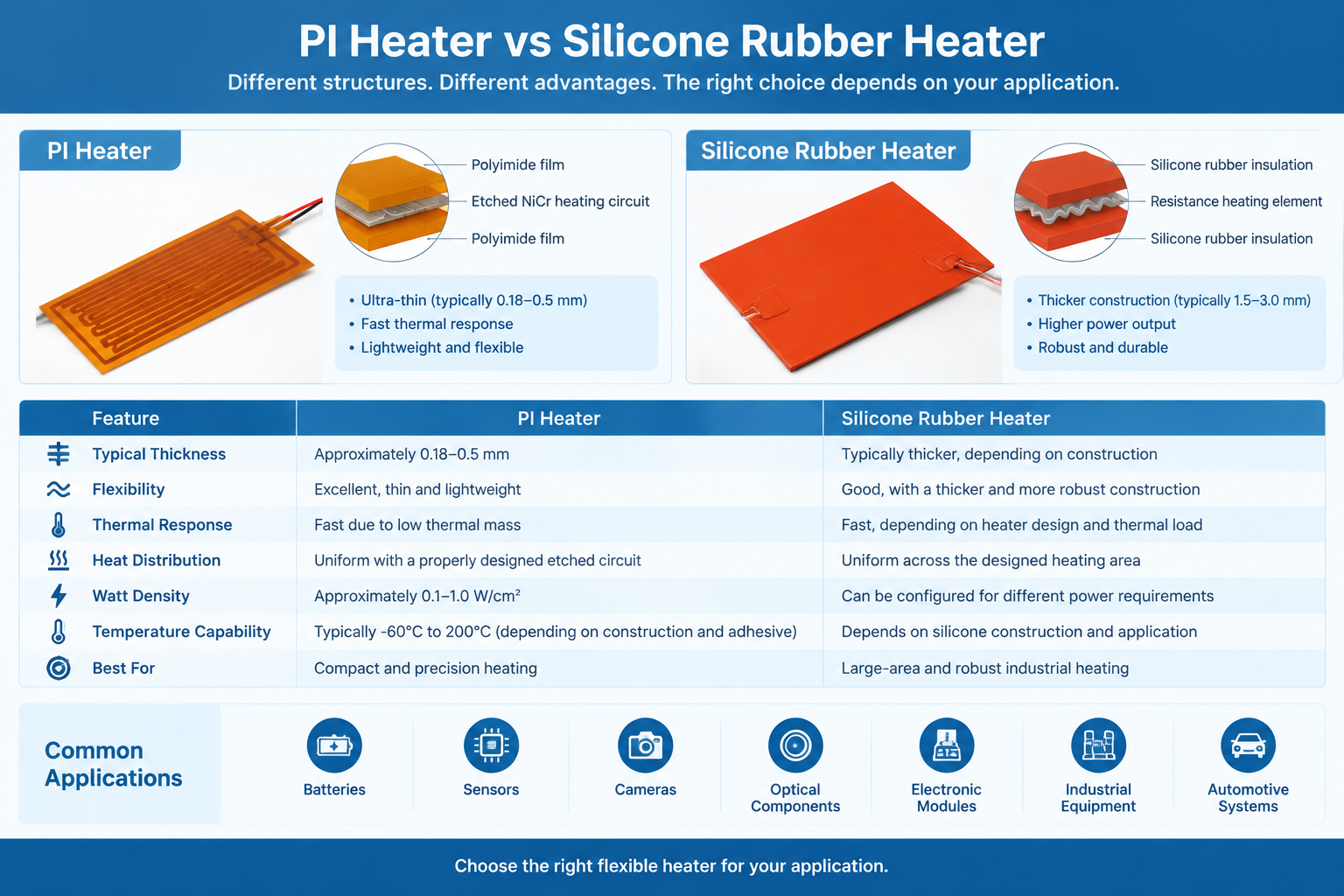
PI Heater vs Silicone Rubber Heater: Core Structure Comparison
PI Heater: An etched Ni-Cr foil heating circuit is encapsulated between layers of polyimide film. Typical thickness is only 0.15–0.25 mm, making PI heaters suitable for ultra-thin, lightweight, and space-limited applications.
Silicone Rubber Heater: A resistance heating element is embedded inside silicone rubber insulation. The thicker and more durable structure makes silicone rubber heaters suitable for larger heating surfaces and industrial environments.
Performance Comparison
| Feature | PI Heater | Silicone Rubber Heater |
|---|---|---|
| Typical Thickness | 0.15–0.25 mm | Typically 1.5–3.0 mm |
| Flexibility | Excellent, ultra-thin and lightweight | Good, thicker and mechanically stronger |
| Thermal Response | Very fast due to low thermal mass | Fast depending on heater design |
| Heat Distribution | Uniform heating with etched foil circuit | Uniform heating across designed area |
| Watt Density | Typically 0.1–0.6 W/cm² | Higher power configurations available |
| Best Application | Precision and compact heating | Large-area and industrial heating |
When Should You Choose a PI Heater?
A PI heater is suitable when the application requires minimal thickness, low weight, fast thermal response, or heating in limited installation spaces.
- Ultra-thin heating design
- Battery and electronic component heating
- Sensor and optical component temperature control
- Compact medical and laboratory equipment
- Applications requiring fast temperature response
Standard PI heaters are available in 12V and 24V DC configurations. Custom shapes, cut-outs, lead positions, and integrated K-type or J-type thermocouples are available.
For detailed selection information, see How to Choose a PI Heater.
When Is a Silicone Rubber Heater Better?
A silicone rubber heater is often preferred when larger heating areas, higher power output, or stronger mechanical durability are required.
- Large surface heating
- Tanks, pipes, molds, and industrial equipment
- Higher watt density requirements
- Applications requiring robust flexible heating
- Automotive and battery thermal systems
For standard and custom configurations, see our Silicone Rubber Heater product page.
PI Heater vs Silicone Rubber Heater: Quick Selection Guide
| Requirement | Recommended Solution |
|---|---|
| Extremely limited installation space | PI Heater |
| Fast thermal response | PI Heater |
| Large heating surface | Silicone Rubber Heater |
| Higher mechanical durability | Silicone Rubber Heater |
How to Choose Between PI and Silicone Rubber Heaters
The correct flexible heater depends on the complete application requirements, including:
- Available installation space
- Heating area size
- Required voltage and wattage
- Operating temperature
- Heating speed requirements
- Mounting method
- Temperature sensing requirements
- Operating environment
For silicone rubber heater selection details, see our Silicone Rubber Heater Selection Guide .
Need Help Choosing the Right Flexible Heater?
If you are unsure whether a PI heater or silicone rubber heater is suitable, send us your application requirements. EaseWise can recommend a suitable heater structure and provide standard or custom solutions.
Please provide:
- Heater size or heating area
- Working voltage
- Required wattage
- Target temperature
- Installation surface
- Quantity requirement
- Sensor requirement
For stock sizes and custom configurations, visit our Standard Etched-Foil PI Heater product page.
Email: Amy-Easewise@tzheater.com
WhatsApp: +86 188 8318 8154
Hanna – Sales
Email: Hanna-Easewise@tzheater.com
WhatsApp: +86 173 5163 6811
Standard PI heaters and custom flexible heating solutions are available for OEM applications.