
Oil Drum Heater Selection Guide: Real-World Sizing Calculation
Choosing the right Oil Drum Heater requires more than matching the heater to the drum size. The material inside the drum, target temperature, ambient conditions, heating time and required power all affect the final heater selection.
If you are new to drum heating, see our guide What Is an Oil Drum Heater? to learn how drum heaters work and where they are commonly used.
This practical example shows how to estimate the heating requirements for a real drum heating application and select a suitable heater.
Oil Drum Heater Sizes and Applications
Drums and containers come in different sizes, so the heater must provide enough surface coverage and heating power for the specific container. Common applications include heating oil, syrup, resin, chemicals, adhesives and other viscous materials.
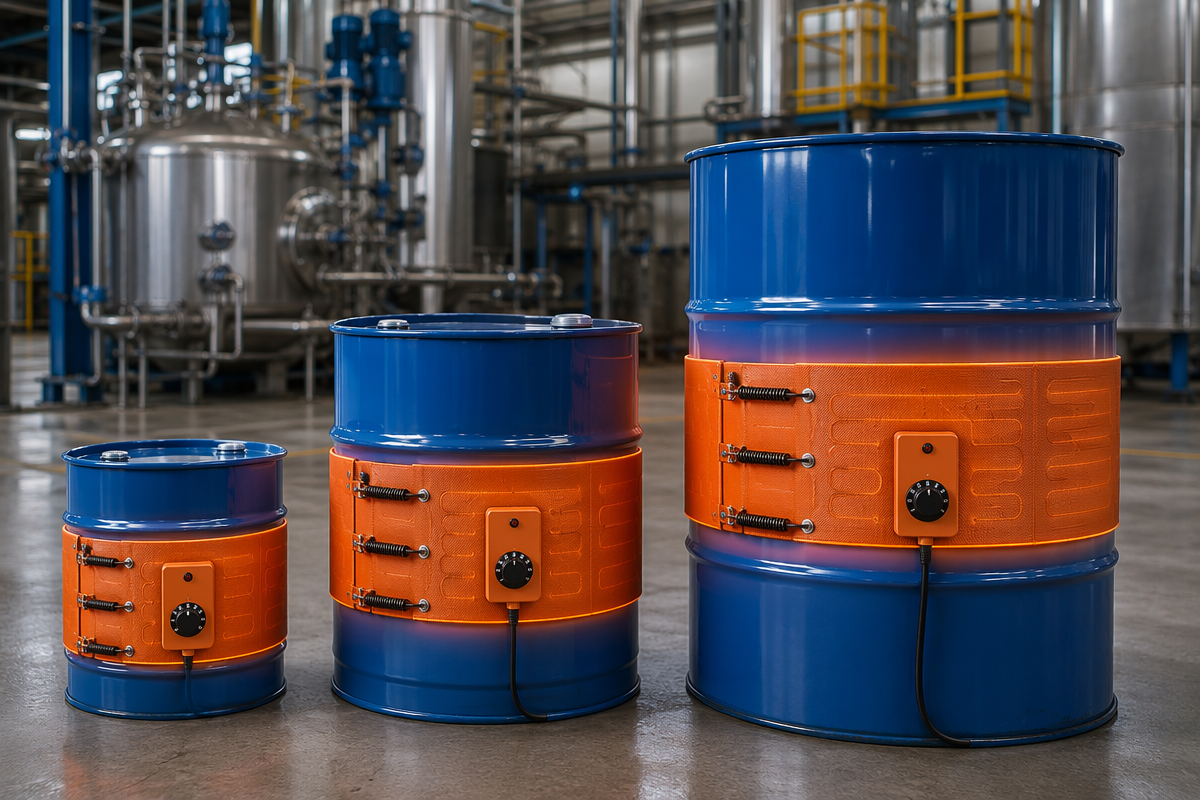
Different drum capacities require different heater dimensions and power levels. Selecting the heater according to the actual drum size helps provide more uniform heating and better temperature control.
Real-World Oil Drum Heater Selection Example
Case: Customer A, syrup heating application
The customer needs to heat high-viscosity syrup inside a metal drum. The main goal is to reduce the syrup viscosity and make it easier to pump or process.
Customer’s Actual Parameters
- Drum outer diameter: 58 cm
- Drum height: 88 cm
- Material: High-viscosity syrup
- Ambient temperature: 20°C
- Target temperature: 60°C
- Heating time: Approximately 2 hours
How to Calculate Oil Drum Heater Power
The required heating power depends mainly on the amount of material, its specific heat capacity, the required temperature increase and the desired heating time.
A basic calculation can be made using:
Q = m × c × ΔT
- Q = required heat energy
- m = material mass
- c = specific heat capacity
- ΔT = temperature increase
For a practical drum heating application, additional heat losses should also be considered. Heat can be lost through the drum surface, surrounding air and the drum lid or bottom.
For background information on specific heat capacity and related thermal properties, refer to the Engineering ToolBox specific heat capacity reference.
Step 1: Estimate the Heating Load
Assume the drum contains approximately 200 kg of syrup and the estimated specific heat capacity is 2.5 kJ/(kg·°C).
The required temperature increase is:
ΔT = 60°C − 20°C = 40°C
The theoretical heat energy is therefore:
Q = 200 × 2.5 × 40 = 20,000 kJ
To convert this energy requirement into heating power, consider the required heating time of approximately 2 hours.
Required theoretical power ≈ 2.78 kW
Because actual applications have heat losses, the heater should not be selected exactly at the theoretical value. A practical safety margin is normally required.
Step 2: Allow for Heat Loss
In a real application, heat is continuously transferred from the drum to the surrounding environment. Therefore, selecting a heater with additional power helps compensate for these losses and provides a more reliable heating process.
For this example, a heater in the approximate range of 3.5–4 kW may be considered as a practical starting point, depending on the drum insulation, ambient conditions and actual heating performance required.
Oil Drum Heater Selection Considerations
Power is only one part of the selection process. The heater dimensions and control method should also match the application.
1. Drum Size
The heater should fit the circumference and heating area of the drum. A properly sized heater provides better contact with the drum surface and helps distribute heat more evenly.
2. Material Being Heated
Different materials respond differently to heating. High-viscosity materials such as syrup, resin and adhesives may require controlled and gradual heating to avoid overheating the material near the drum wall.
3. Target Temperature
The required temperature determines the heating power and control requirements. For temperature-sensitive materials, a thermostat or temperature controller can help maintain a stable heating range.
4. Heating Time
If the process requires faster heating, a higher-power heater may be necessary. If heating time is less critical, a lower-power heater may provide a more economical solution.
5. Insulation
Adding thermal insulation around the drum can reduce heat loss. This can improve heating efficiency and help the heater reach the target temperature more consistently.
Why Choose a Custom Oil Drum Heater?
Standard drum heaters are suitable for many common applications, but custom solutions may be preferable when the drum size, material or heating requirements are unusual.
EaseWise can provide customized heating solutions based on drum dimensions, voltage, power, temperature requirements and application conditions.
- Custom drum heater dimensions
- Different voltage and power options
- Thermostat or temperature control options
- Suitable solutions for different drum capacities
- OEM and customized heating solutions
For standard 20L and 200L drum configurations, visit our Oil Drum Heater product page to review available sizes, power options and temperature controls.
For larger industrial requirements, you can also explore our Industrial Drum Heater solutions.
Oil Drum Heater vs Drum Heating Blanket
The terms used for flexible drum heating products can sometimes be confusing. Some designs provide additional insulation, while others focus on direct heating contact with the drum surface.
If you are comparing these heating options, read our guide Oil Drum Heater vs Drum Heating Blanket to understand the main differences in construction, insulation and typical applications.
Final Oil Drum Heater Selection Tips
For a reliable drum heating solution, do not select a heater based on drum size alone. Consider the drum dimensions, material type, material quantity, target temperature, heating time and heat loss together.
For the example above, the theoretical heating requirement is approximately 2.78 kW, while a practical selection of around 3.5–4 kW provides additional capacity to compensate for heat losses. The final heater specification should be confirmed based on the actual operating conditions.
If you are unsure which heater is suitable for your application, provide us with your drum size, material, target temperature and required heating time. Our team can recommend a suitable heating configuration.